Token lags major cryptocurrencies despite regulatory clarity
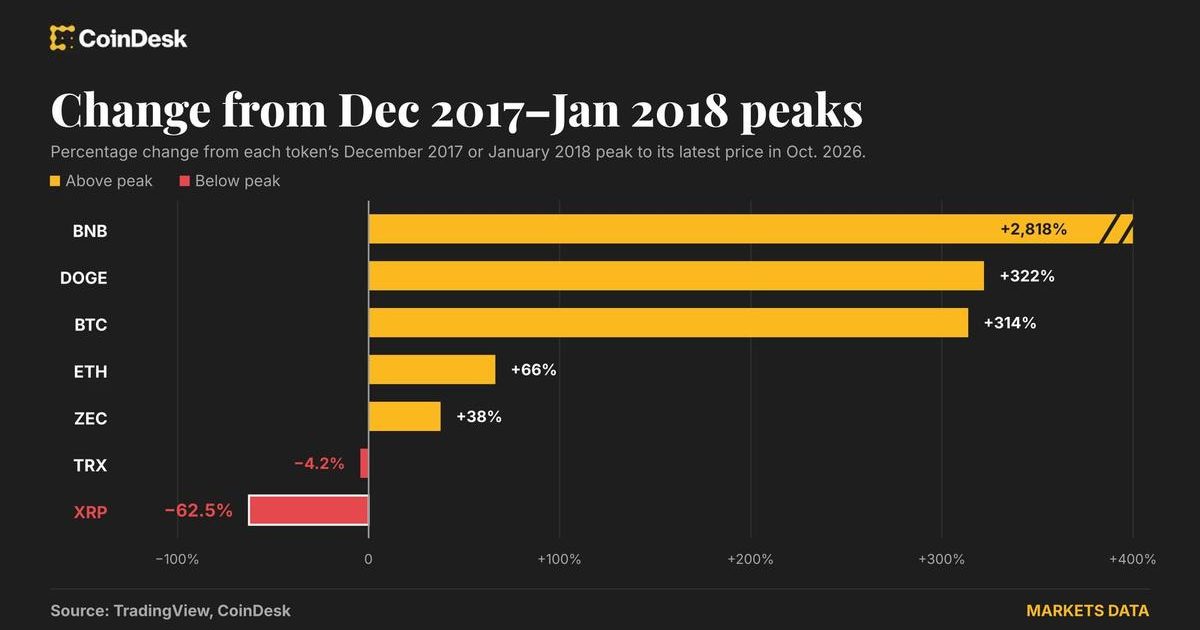
XRP has remained trapped below its January 2018 peak of $3.55, trading at $1.33 as of mid-October 2026, even as Bitcoin, Ether, Dogecoin, and BNB have all surpassed their previous cycle highs by substantial margins. The world’s fifth-largest digital asset by market value has declined 62.5% from its 2018 peak, while Bitcoin has gained 314% and BNB has climbed 2,800% over the same period.
The underperformance persists despite regulatory resolution. A federal judge ruled in 2023 that XRP sales on public exchanges were not securities offerings. The SEC case ended in August 2025 with both sides dropping appeals, removing a major overhang that had shadowed the token since December 2020, when the regulator sued Ripple and two executives.
Supply dynamics partially explain the gap. XRP’s circulating supply grew 63% from 2017 to the present, expanding from 38.7 billion tokens to 63.1 billion. According to Nicolai Sondergaard, senior research analyst at Nansen, “Circulating supply grew 63%, from 38.7B in 2017 to 63.1B, while XRP’s total market value fell only about 3%. More XRP in circulation means each token represents a smaller share of roughly the same total value.”
Oliver Carding, head of marketing at Tesseract Group, an institutional digital asset management firm with $500 million in assets under management, offered a similar assessment: “On value, XRP recovered. About 63% more XRP is in circulation than at that peak, so the same circulating market capitalization would mean a price roughly 39% lower.”
XRP briefly touched $3.66 in July 2025, approaching the 2018 high before retreating sharply. Since August 2025, when the SEC case concluded, XRP has declined 59%, compared to 32% for Bitcoin and 44% for Ether. The token’s circulating market capitalization has fallen 56% over the same period.
Narrative and product shifts
Beyond supply and legal factors, XRP has struggled to capture the investment narratives that have driven other tokens. Paul Howard, senior director at Wincent, a market-making firm, noted that “ETF uptake has also been muted relative to $BTC and $ETH.” XRP ETF investor inflows since their debut totaled $1.80 billion, a fraction of comparable inflows for Bitcoin and Ether products.
Ripple’s strategic focus has also shifted. According to Howard, “Ripple, meanwhile, has been working hard to build payment infrastructure, RLUSD and trade financing products around the usage of the ledger and coin, and this has taken focus from just core XRP.” He added that “The role of DeFi for investment into ETH, SOL and HYPE has also been a new narrative which $XRP has not focused on.”
Trading activity reflects broader investor caution. XRP spot trading volume has declined 53.5%, while perpetual futures volume has fallen 44%. Active addresses on the XRP Ledger have dropped 10.7%.
Carding cautioned that the regulatory resolution alone does not guarantee recovery. “The SEC case helps explain why XRP did not revisit its 2018 high in 2021, when Coinbase suspended trading, but the appeals were dropped in August 2025 with XRP above $3. Since then, XRP is down about 59%, against 32% for bitcoin and 44% for ether, and its circulating market capitalisation is down about 56%.”
Looking forward, Carding identified key metrics to monitor: “What I would watch is XRP against bitcoin, alongside net monthly distribution after re-escrow and changes in fund holdings. Relative weakness that persists as distribution slows would point to weaker demand.”