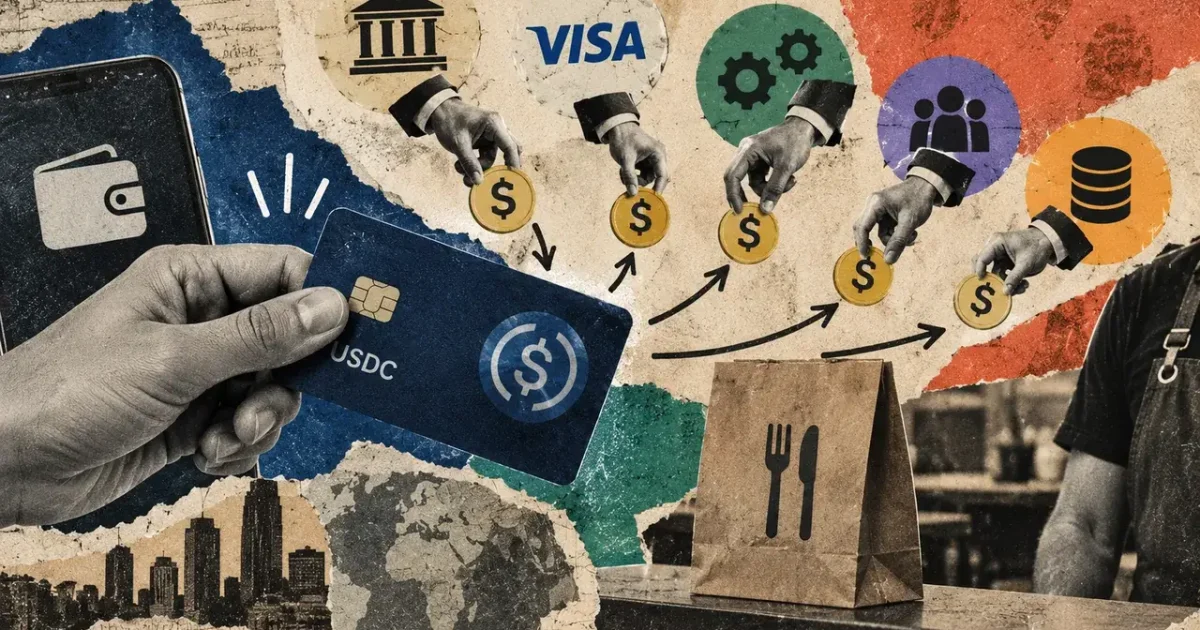
Visa reported more than 160 stablecoin-linked card programs on October 1, with payment volume rising nearly 200% year-over-year. The growth reflects expanding infrastructure for spending USDC through card networks, where payment providers convert customer stablecoins into merchant local currency while handling settlement and fraud prevention.
The payment network enables stablecoin card spending through partnership with Bridge, a stablecoin card infrastructure provider acquired by Stripe in 2025. Customers in Colombia can spend stablecoins while merchants receive Colombian pesos, with Bridge handling the conversion so merchants and payment providers do not need to accept cryptocurrency directly.
Infrastructure and Fee Distribution
Card payment processing involves multiple participants: card issuer, wallet or card brand, card network, and merchant’s payment provider, each requiring revenue to cover their role. Interchange fees paid by merchant’s bank to card issuer fund part of card issuer revenue. Bridge advertises allowing program operators to retain 100% of interchange while charging additional transaction fees.
Wirex, another stablecoin card infrastructure provider, processes more than $200 million in monthly spending through programs using its infrastructure, including partner activity, according to Pavel Matveev, Wirex co-founder and CEO. Wirex card rewards are tied to subscription tiers and token lockups.
Rain, a third infrastructure provider, uses a revolving credit facility from Credit Coop to meet Visa settlement obligations. Incoming cardholder proceeds are directed through smart contracts to repay borrowing. Visa claims the Credit Coop financing arrangement has reduced borrowing costs by as much as 30% for some participants, though underlying terms and credit risk allocation remain undisclosed.
Regulatory Environment and Economics
Britain’s Payment Systems Regulator caps interchange at 0.2% for debit transactions and 0.3% for credit transactions. These caps constrain revenue available to card issuers in the UK market. On a £100 debit purchase, the maximum interchange is 20 pence. A 2% cashback reward on a £100 purchase costs £2, creating a funding gap of £1.80 that must be covered by other revenue sources or cross-subsidies.
Stablecoin cards offer greatest advantage to people already receiving or holding digital dollars, such as freelancers paid in stablecoins. Visa supports USDC settlement between participating financial institutions, enabling direct stablecoin-to-fiat conversion at the point of sale.
The economics of stablecoin card programs depend on managing borrowing costs and settlement timing. At a 10% annual borrowing rate, the approximate cost of borrowing $1 million for one day is $274, while borrowing for six hours costs approximately $68. Program operators must balance these financing costs against transaction fees and interchange revenue.