Military action near Hormuz shifts ceasefire from relief into active risk scenario
US military strikes near the Strait of Hormuz on May 26 transformed a tentative ceasefire extension into a live test of oil market stability, Federal Reserve rate expectations, and Bitcoin’s macro constraints simultaneously.
CENTCOM characterized the strikes as “self-defense” operations. The action came one day after Nikkei reported a US-Iran ceasefire extension plan on May 25. An Iranian government spokesperson said a deal was “not imminent,” signaling continued friction over key issues including Iran’s Hormuz blockade.
The ceasefire itself, extended for 60 days from an early-April agreement, carried nuclear talks during that window and promised to reopen the Strait of Hormuz roughly 30 days from a final deal. But the fresh strikes demonstrate that risk has shifted from theoretical to active.
Oil flows and inflation expectations collide
The Strait of Hormuz moved 20.9 million barrels per day in the first half of 2025, representing 20% of global petroleum consumption and one-quarter of seaborne oil trade. Pre-war tanker traffic averaged 125 to 140 daily passages. Only several tankers crossed recently, signaling that normalization takes months, not hours.
Brent crude briefly exceeded $112 on May 18, when Trump warned Iran “clock is ticking.” The benchmark rebounded after earlier declines, though it fell below $100 on peace-deal hopes. WTI fell 6% in early May on those hopes. Lower oil eases inflation anxiety and reduces safe-haven demand for dollars.
But Fed officials on May 20 opened to the possibility that rates may need to rise, citing inflation worries tied to war escalation. Bank of America and Goldman Sachs pushed back Fed cut expectations on May 11. Bank of America now expects the Fed to stay on hold for the rest of 2026. Goldman Sachs delayed its first expected cut to December 2026 and a second cut to March 2027. Markets previously priced two 2026 Fed cuts before hostilities began. Current market pricing assigns 40% probability to a 25-basis-point Fed hike in December 2026.
Bitcoin’s macro ceiling under pressure
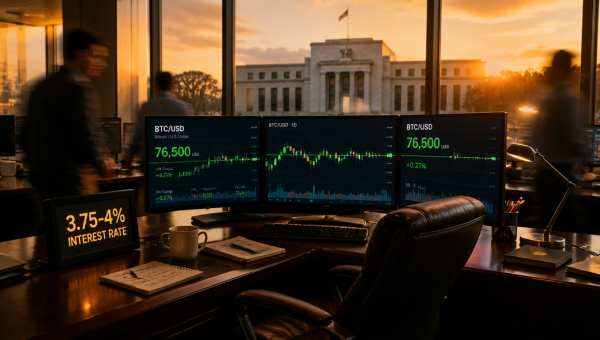
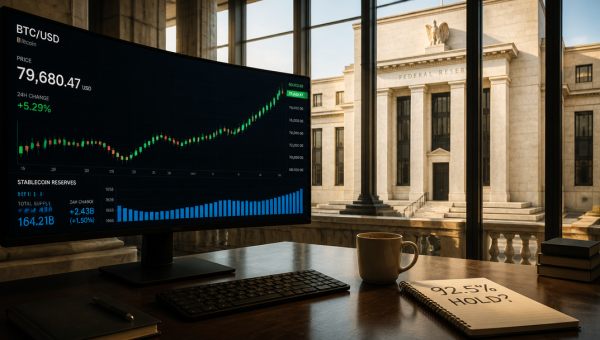
Bitcoin traded near $76,000 mid-range during ceasefire discussions and $77,500 near article publication on May 26. The asset climbed toward $82,000 in May on WTI declines but dropped to $76,500 on May 18 after Trump’s warning to Iran.
The volatility reflects Bitcoin’s sensitivity to three overlapping macro variables: oil disruption risk, which raises inflation expectations; Fed rate policy, which determines the cost of capital for risk assets; and the dollar’s safe-haven status, which competes with non-yielding assets during geopolitical stress.
The Iranian government’s statement that even if the strait reopens, return to normal oil flows could take months, compounds the uncertainty. Markets can reprice an oil drop within hours. But the Fed must price a full oil shock including the possibility the 60-day window ends without a deal and Brent retraces its decline within days. That asymmetry leaves Bitcoin vulnerable to whipsaw moves as each new headline reshuffles the probability of Fed action and energy costs.