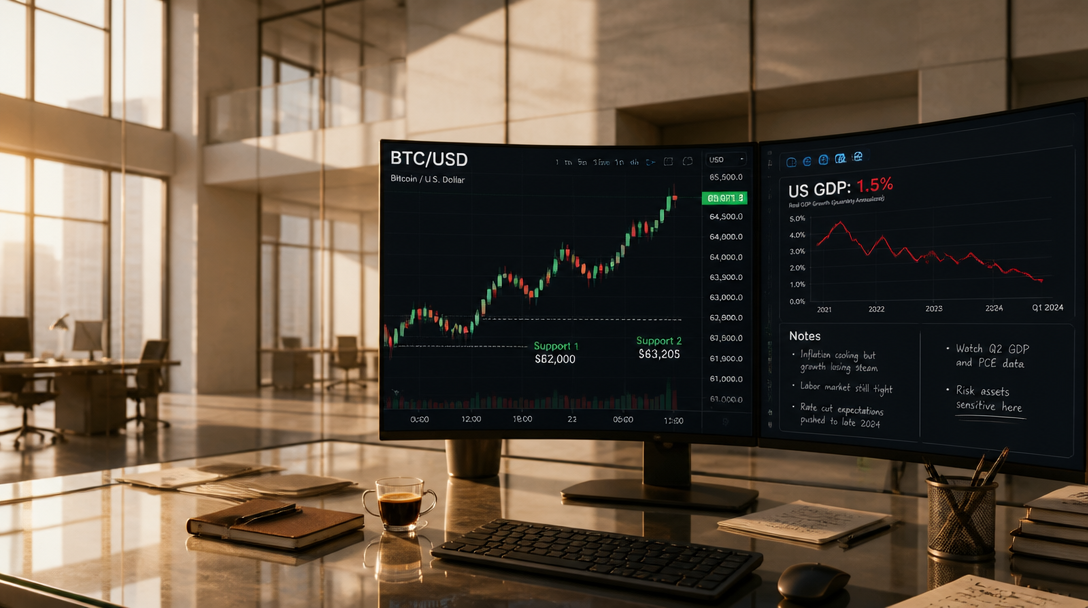
Bitcoin briefly topped $65,071 on Thursday following a US second-quarter GDP growth report that came in at 1.5%, below the 2.1% forecast and first-quarter pace. The move marked an initial market response to weaker economic expansion, though strong household spending and persistent inflation tempered bullish momentum.
The Federal Reserve held its benchmark rate at 3.50% to 3.75% on Wednesday, with three officials voting in favor of a rate increase. Weaker GDP growth typically increases pressure on the central bank to ease monetary policy, which would reduce the appeal of cash and government bonds while improving liquidity for risk assets.
“Once one looks beneath the topline, growth looks much firmer and inflationary,” Joseph Brusuelas, principal and chief economist at RSM US, said of the mixed economic data.
The Inflation Headwind
The US economy’s slowdown was concentrated in trade rather than domestic demand. The widening trade deficit subtracted about one percentage point from headline growth, with much of the import increase attributed to equipment needed to sustain AI investment.
Household spending grew at a 3.2% annualized rate in the second quarter, up from 0.5% in the first quarter. The gross domestic purchases price index rose 5.7% annualized in Q2, while core personal consumption expenditures increased 3.4%, both remaining above the Federal Reserve’s 2% inflation target. This combination of resilient consumer demand and elevated price pressures reduces the likelihood of near-term rate cuts or easier liquidity conditions.
On-Chain Positioning
Bitcoin intraday lows reached $63,205 on Thursday, with the price at $64,729 at press time. The $62,000 to $68,000 range contains the largest concentration of investor cost bases, with long-term holders controlling about half the supply in this band and shorter-term investors holding the remainder.
The next significant test level sits at $69,000, where aggregate short-term holder cost basis is concentrated. Repeated attempts to push Bitcoin below $62,000 to $63,000 have failed, according to blockchain analytics firm Glassnode.
Liquidity and Volume Signals
Spot trading volume measured in Bitcoin has fallen to its lowest level since 2019, according to CryptoQuant data. Combined exchange deposits and withdrawals are near their quietest levels in three years, suggesting reduced institutional activity or positioning shifts.
The three-month Bitcoin futures basis has remained below the two-year Treasury yield since February, marking only the second prolonged period on record in which government debt offered higher returns than the Bitcoin trade. This dynamic reflects the persistence of higher rates and reduced leverage appetite in crypto markets.
US spot Bitcoin ETFs returned to modest net outflows after briefly attracting fresh capital in mid-July. The taker buy-sell ratio near 1.0 indicated neither aggressive buyers nor sellers had established clear control over near-term price direction.