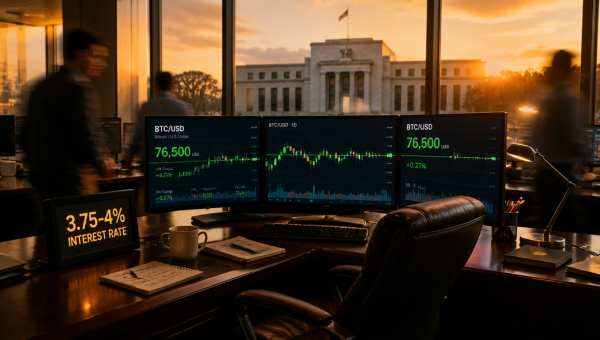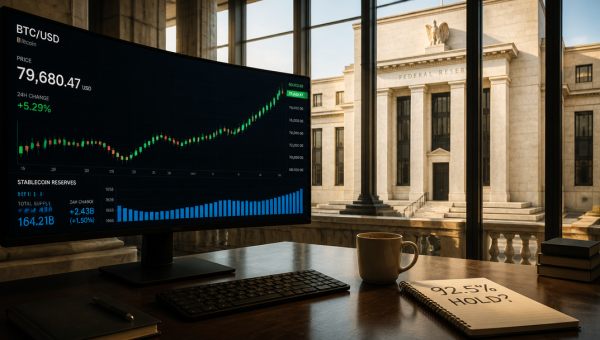
Bitcoin recovered to $65,155 on Monday as a temporary halt in US-Iran military strikes revived appetite for risk assets ahead of a Federal Reserve rate decision Wednesday, according to CryptoSlate.
The geopolitical pause, in which Washington halted strikes on Iran and Tehran said it would suspend attacks as long as the United States did the same, coincided with a 6.5% decline in Brent crude to $90.45 per barrel. Oil had exceeded $100 last week, a surge that had shifted market expectations for Fed action. The combination of reduced geopolitical tension and falling energy prices altered inflation forecasts just ahead of the central bank’s two-day meeting.
Ethereum climbed 4% to around $1,964 alongside Bitcoin’s 1% rise, reflecting a broader shift toward risk-on positioning in crypto markets.
Inflation Data Reshapes Rate Expectations
The June consumer price index, released July 14, showed a monthly decline of 0.4%, the largest monthly CPI drop since April 2020. Annual inflation slowed to 3.5% from 4.2% the prior month, while core inflation eased to 2.6% from 2.9%. Energy accounted for much of the improvement, with the energy index falling 5.7% in June after rising in the previous three months.
That initial report appeared to strengthen the case for Federal Reserve patience. But the subsequent oil surge above $100 changed market pricing dramatically. By Monday, futures markets priced a one-in-three probability of a 25-basis-point rate increase at Wednesday’s decision, up sharply from 16% probability one week earlier. Two-thirds of the market still expected the Fed to hold rates at the current 3.50% to 3.75% target range.
The Fed held rates steady at its June meeting and cited supply shocks including energy as contributing to elevated inflation. Energy remains an area where supply disruptions were pushing prices higher, according to the Fed’s June statement.
Volatility Positioning Shifts Lower
Options traders have reduced defensive positioning in Bitcoin. The put-to-call ratio fell to 0.52 from 0.76 in late June, indicating calls now represent a larger share of outstanding positions than puts.
One-week at-the-money implied volatility stands at 34.3%, while six-month implied volatility is at 40.8%. The upward-sloping volatility curve suggests traders assign little premium to immediate market turbulence while pricing greater uncertainty further out. One-week 25-delta skew is at 4%, with three- to six-month skew ranging from 11% to 12%.
Fed Leadership and Rate Projections
Federal Reserve Chair Kevin Warsh provides less forward guidance than previous Fed leadership, placing more weight on individual economic releases. This approach means each data point carries outsized significance for market expectations.
Nine of 18 Fed officials are projecting a year-end 2026 rate above the current midpoint. The median Fed official year-end projection stands at 3.8%. Separately, markets are pricing a 77% probability of a rate increase by September.
The Commerce Department is scheduled to release the Q2 GDP estimate, June personal income and spending data on Thursday, July 31, potentially providing additional context for the Fed’s path forward.