Bank of Japan’s June 15-16 meeting puts yen carry trade and risk assets under pressure
Bitcoin is now trading into a critical macroeconomic pivot. The Bank of Japan is meeting June 15-16 to decide whether to raise its policy rate to 1% for the first time since 1995, a move that 94% of economists expect by the end of June. That decision will determine whether yen carry-trade unwinding pressures Bitcoin and other risk assets, or whether dovish signals from the BOJ cushion the blow.
The mechanism is straightforward. A BOJ rate hike would tighten funding costs for investors who borrow yen cheaply near zero rates and deploy capital into higher-yielding assets elsewhere. Leveraged funds are holding very large short exposure against the yen as of June 9, according to CFTIC data. If the BOJ raises rates without pausing its bond-purchase taper, a rapid yen rally could force deleveraging across equities, commodities, and Bitcoin.
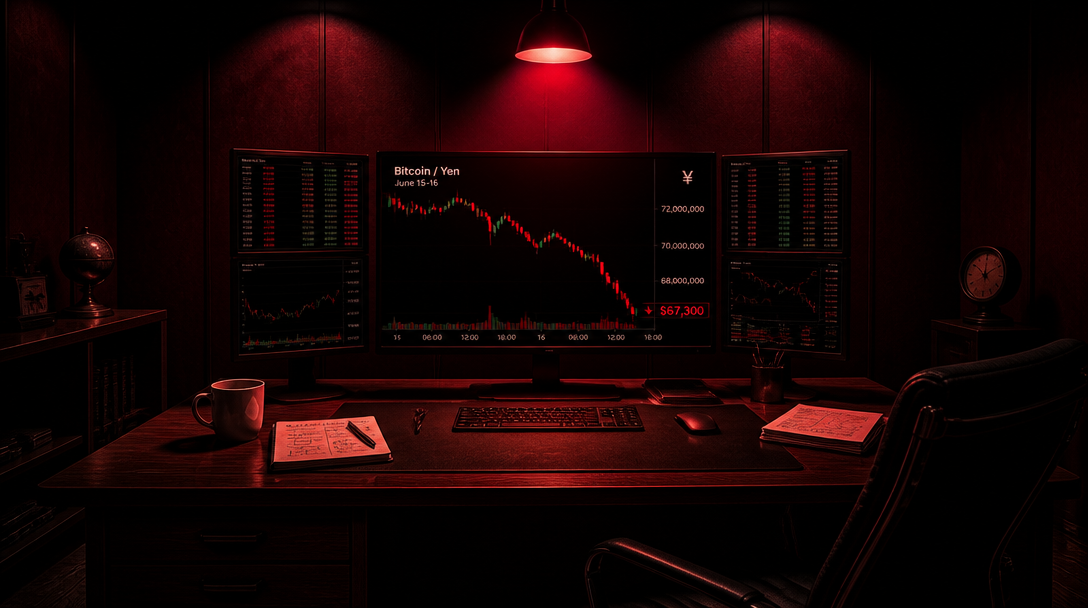
Bitcoin rallied to an intraday high near $67,300 on June 15 as markets digested the Iran-US framework agreement to halt conflict and reopen the Strait of Hormuz. That deal sent Brent crude down roughly 5% to $82.95 and reduced inflation expectations across asset classes. Bitcoin has been moving in lockstep with oil, equities, and the dollar, behaving as a macro risk asset.
Japan’s government spent a record ¥11.7 trillion supporting the yen in April and May after it slid past 160 against the dollar. The BOJ faces a policy dilemma: a rate hike is hawkish and tightens funding, but a bond-purchase taper pause is dovish and cushions balance-sheet tightening. A hike could be absorbed as controlled normalization if paired with dovish language and a taper pause, or could trigger deleveraging if signaled as part of a more aggressive hiking path.
Bitcoin ETF flows have been volatile. The asset class saw outflows through most of the May 27 to June 11 period, with only June 12 breaking the streak at $85.9 million net inflow. According to Citi, ETF flows account for 45% of weekly Bitcoin price moves, making institutional positioning a key variable heading into the BOJ decision.
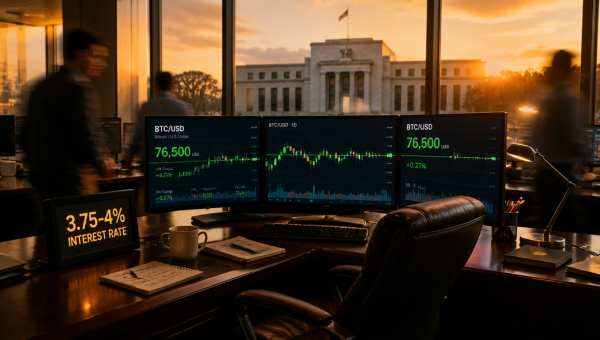
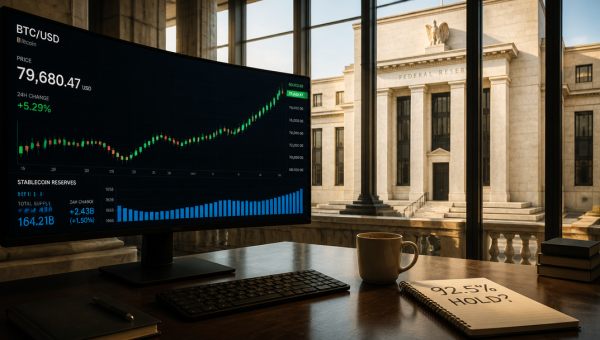
Open interest in Bitcoin futures rose 4% to 748,000 BTC, with funding rates near negative 1%, signaling short positioning ahead of the meeting. The Federal Reserve is expected to hold rates at 3.50%-3.75% this week, with reports flagging a potential shift toward more neutral or hawkish communication under new Chair Kevin Warsh.
Scenarios for Bitcoin depend on global growth assumptions tied to Middle East stability. The IMF’s April outlook projected 3.1% global growth for 2026 under contained conflict. The OECD in June offered two scenarios: 2.8% growth if disruption is time-limited, and 2.1% if it persists. Bitcoin’s bull case targets $70,000 to $75,000. Base case holds $64,000 to $70,000. Bear case retracement extends to $60,000 to $64,000.
Japan’s inflation backdrop supports a BOJ move. Producer prices rose 6.3% year-over-year in May, above the 5.5% forecast. Yen-based import prices jumped 25.5%, reflecting currency weakness and energy costs. The BOJ’s next policy decision window for a bond-purchase taper pause runs through April 2027, with a potential floor of ¥2.1 trillion in monthly JGB purchases under pause, down from ¥2.7 trillion in the April-June 2026 window.
Oil may find a new floor around $75 to $80 given low inventories and a slow pace of supply normalization after the Hormuz reopens. That dynamic will shape whether Bitcoin’s correlation with crude persists or breaks as central bank policy divergence takes hold.