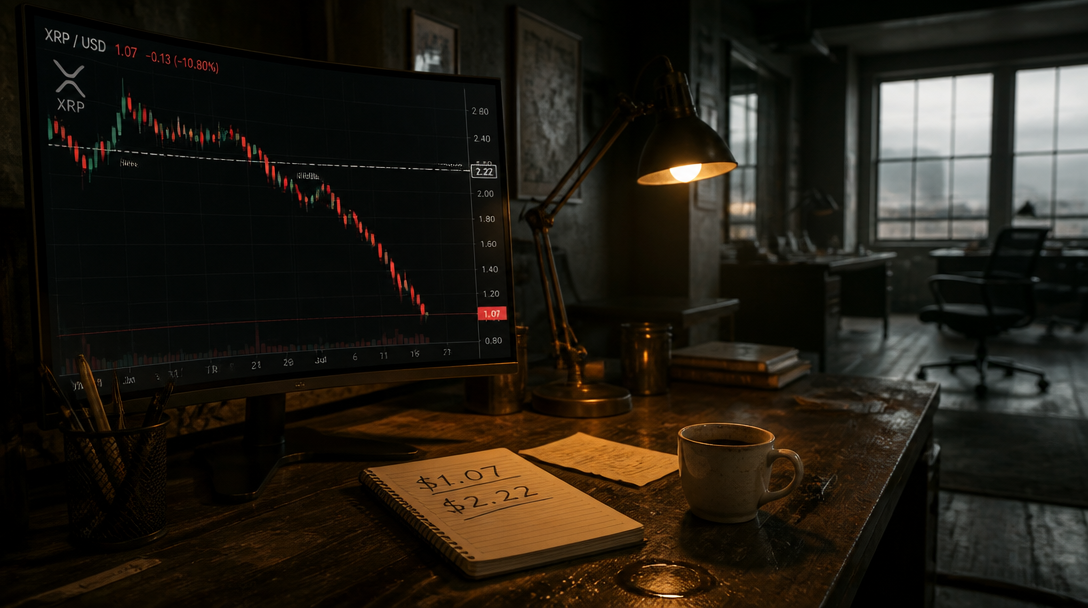
XRP traded near $1.07 on July 14 while on-chain analytics firm Glassnode identified a sharp divide in holder profitability across time cohorts, with six-to-12-month holders carrying a $2.22 average cost basis, according to the firm’s analysis of realized prices.
The gap represents a 52% shortfall from breakeven for that cohort. Holders who accumulated XRP between one and two years ago face an even steeper climb: with a $1.89 realized price, the current spot sits roughly 43% below their cost, and they would need a rally of about 77% to return to breakeven. For the six-to-12-month group to return to cost basis, XRP would need to rally 107% from current levels.
Recent buyers, defined as those who acquired coins in the past month at an average realized price of $1.09 to $1.11, remain closer to breakeven. A move to $1.11 would allow that cohort to turn profitable. The aggregate realized price across all holders stands at $1.36, leaving the broader holder base underwater.
Funding Rates Signal Mixed Positioning
Perpetual funding rates across major exchanges reveal fragmented sentiment among derivatives traders. Kraken’s XRP perpetual contract carried a negative funding rate of -0.016%, meaning shorts are paying longs, a signal of short-side pressure. Coinbase perpetuals showed -0.003% funding, while Bybit and Crypto.com both registered -0.002%.
Binance XRP perpetuals held at 0% funding, neither charging longs nor shorts. Gate.io turned positive at +0.005%, followed by Hyperliquid at +0.006% and Bitget and Huobi each at +0.010%, indicating pockets of long-side crowding. The 2.6 basis point range between the lowest and highest rates reflects venue-specific differences in user composition, margin preferences, and contract volume, according to derivatives data provider CoinGlass.
XRP futures volume reached $1.7 billion over 24 hours, compared to $290.4 million in spot volume, a 5.9-to-1 ratio favoring derivatives. Open interest stood at $2.3 billion, indicating substantial leverage deployed across the market.
ETF Flows Break Broader Trend
US spot XRP ETFs recorded net outflows of $7.2 million during the July 6 to July 10 period, led by a $7.29 million outflow from the Bitwise XRP fund and partially offset by smaller inflows elsewhere. The outflows reversed an earlier pattern: during the same week, US spot Bitcoin ETFs pulled in $197 million, ending an eight-week run of redemptions.
Glassnode’s Net Unrealized Profit/Loss (NUPL) indicator, which measures aggregate holder profitability, registered -0.252, confirming that the majority of circulating XRP supply remains in loss. The firm calculates realized price as the average price at which circulating supply last moved on-chain, tracking holding duration separately per cohort, though the methodology captures both ordinary buying and transfers or custody changes.
Macro Backdrop and Liquidity Pressures
Money markets priced in 37 basis points of Federal Reserve tightening for the year following the Fed’s June 17 decision to hold its target rate at 3.50% to 3.75%. That tightening backdrop tends to compress liquidity for higher-beta assets like XRP. Renewed US-Iran hostilities on July 13 pushed Brent crude up 2% to $77.60 and supported the dollar as a safe-haven asset, headwinds for risk assets denominated in fiat.
Frequently Asked Questions
What was XRP's price on July 14?
XRP traded near $1.07 on July 14, while the aggregate realized price across all holders stood at $1.36, leaving the broader holder base underwater.
How does XRP futures volume compare to spot volume?
XRP futures volume reached $1.7 billion over 24 hours, compared to $290.4 million in spot volume, a 5.9-to-1 ratio favoring derivatives.
Did US spot XRP ETFs see inflows or outflows?
US spot XRP ETFs recorded net outflows of .2 million during the July 6 to July 10 period, led by a .29 million outflow from the Bitwise XRP fund, partially offset by smaller inflows elsewhere.