Trump-Linked Crypto Venture Issues Compliance Notice as Treasury Targets Iranian Platforms
World Liberty Financial, the crypto venture linked to US President Donald Trump, published a compliance notice on June 3, 2026, confirming that its smart contracts contain hard-coded controls to freeze, restrict, or reject cryptocurrency transfers involving sanctioned individuals, organizations, or wallet addresses.
“As a reminder, and in light of recent sanctions updates, World Liberty Financial maintains risk-based sanctions compliance controls designed to support applicable legal and regulatory obligations across relevant jurisdictions. Transactions involving sanctioned persons, entities,…” the venture said in an official statement posted on X.
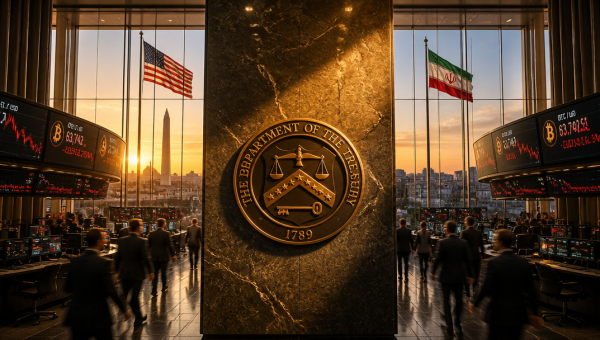
The notice arrived the same day the US Treasury Department sanctioned four Iranian cryptocurrency platforms: Nobitex, Wallex, Bitpin, and Ramzinex. Treasury Secretary Bessent said Nobitex had processed transactions tied to Iran’s Islamic Revolutionary Guard Corps and facilitated fund transfers after US military operations disrupted Iranian communications infrastructure.
“While Iran’s economy is in free fall, the regime has chosen to co-opt digital asset technologies for its own corrupt agenda, including evading sanctions and transferring wealth out of the country,” Bessent said in a statement.
WLFI’s disclosure underscores a structural tension within the venture. The underlying smart contracts operate on public, decentralized rails, but the application layer is bound by federal rules on prohibited transactions. The venture maintains unilateral enforcement capabilities, allowing it to burn or restrict wallet balances at the protocol level.
The move addresses months of scrutiny from US lawmakers. Senators Elizabeth Warren and Jack Reed had previously called on authorities to review whether addresses tied to Russia, North Korea, and Tornado Cash, a blacklisted privacy mixer, bypassed WLFI’s early presale screenings. WLFI rejected those allegations, stating it applies strict anti-money laundering and identity checks and turned away millions of dollars during presale.
Anchor investor Justin Sun reportedly flagged the protocol’s unilateral enforcement capabilities, though the specific nature of his concerns was not disclosed.
The compliance notice does not specify the technical mechanism by which transfers will be delayed, restricted, or rejected, nor does it clarify whether the controls apply retroactively to existing wallet holders or only to new transactions going forward. WLFI also did not detail how its transaction review process will operate in practice.
The hard-coded freeze and restriction powers sit uneasily with WLFI’s decentralized finance branding. While the venture positions itself within the DeFi ecosystem, the centralized control mechanisms embedded in its smart contracts reflect a model closer to regulated financial infrastructure than to the permissionless systems that define much of crypto.
Regulatory Backdrop
The Office of Foreign Assets Control (OFAC), the Treasury Department agency that administers US sanctions, has long pressed cryptocurrency platforms to implement transaction screening. WLFI’s approach, embedding compliance controls directly into smart contract logic, represents one model for satisfying those requirements at scale.
Whether the approach will satisfy regulators or address the concerns raised by Warren and Reed remains an open question. The venture’s presale screening practices were not independently verified, and WLFI has not disclosed specific metrics on how many addresses were rejected or on what grounds.