Governance Proposals Give Token Holders Independent Say in SOL Issuance Decisions
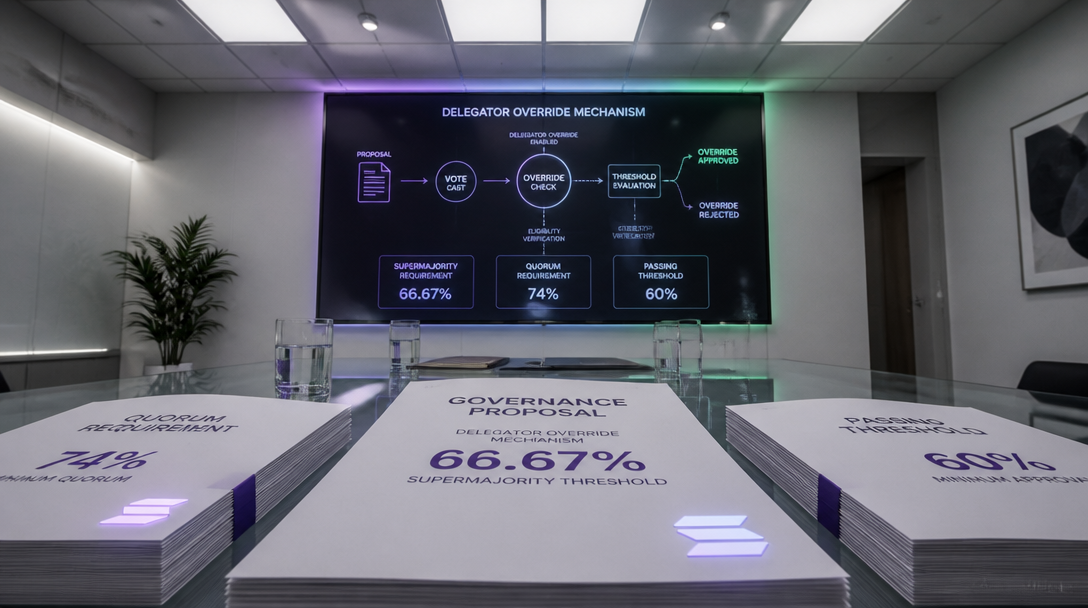
Solana has launched Solana Governance Proposals (SGP), a mechanism allowing delegators to cast independent votes that override their validator’s default position on SOL inflation decisions. The feature addresses a structural imbalance in prior governance rounds where validators controlled all staked tokens by default, concentrating voting power among a small set of operators.
Under SGP, delegators retain the ability to vote separately from their validator’s chosen position. A validator’s weight in any inflation vote is reduced by the amount of SOL its delegators choose to vote independently. For example, a delegator holding 800 SOL in a validator’s vote account can cast that 800 SOL in a direction opposite to the validator’s preference, leaving the validator with only 200 SOL of its original 1,000 SOL stake voting its way.
The mechanism emerged from the failure of SIMD-0228, an inflation-reduction proposal authored by Multicoin Capital’s Tushar Jain and Vishal Kankani. That proposal drew 61.39% approval but required a 66.67% supermajority to pass. Despite roughly 74% of staked SOL participating, the measure fell short. Validators staking 500,000 SOL or less voted against SIMD-0228 over 60% of the time, while larger operators leaned in favor.
SIMD-0228 proposed tying SOL issuance to staking participation and cutting emissions once the network reached a well-secured level. Solana’s inflation schedule began at 8% annually and cuts by 15% each year, with a long-term target floor of 1.5%. The current live inflation rate stands at 3.76%.
Advancing any inflation proposal now requires 15% validator support to reach the voting stage. That threshold translates to 64.2 million SOL, or roughly $5 billion in value, across the network’s 428.1 million SOL in active stake. Proposing a validator’s vote account itself requires a 100,000 SOL minimum stake, worth approximately $7.8 million at current prices.
Smaller Validators Resist Emissions Cuts
Smaller validators argue that issuance cuts threaten decentralization and security economics, since inflation funds the network’s security budget. Helius, a validator economics analyst, tied long-tail validator economics to voting costs, block rewards, MEV, and commission structures alongside inflation. The analysis suggests that cutting emissions without restructuring validator incentives could push smaller operators out of the network.
SGP introduces a new variable into future inflation votes. To flip SIMD-0228 from Against to For would have required a 5.28-point stake shift, equivalent to 16.8 million SOL or $1.3 billion at current prices. Whether delegators will actively override validator votes remains uncertain. The outcome depends on participation rates among retail delegators and custodians, interface usability, and the perceived urgency of inflation reform.
A proposal passes only if For votes represent at least two-thirds of stake voting either For or Against; abstentions are excluded from the calculation. The governance structure now allows token holders to signal preferences independent of validator operators, potentially reshaping how Solana manages its monetary policy.