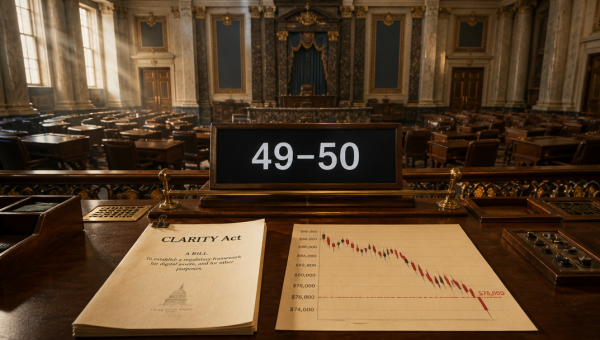
Senate Republicans released an updated version of the CLARITY Act on July 22, advancing one of Washington’s most consequential cryptocurrency bills toward a potential floor vote before the August state work period begins on August 10.
The revised legislation establishes a broad federal market-structure framework for digital assets. It bans presidents, vice presidents, members of Congress, federal judges, and other covered officials from issuing or sponsoring cryptocurrencies for compensation while in office. Those officials must also divest or place existing crypto holdings in blind trusts.
Senator Cynthia Lummis, the lead Republican negotiator, said in a statement: “I want to thank my Democratic colleagues for their important contributions to this draft, and express my commitment to reaching a deal in the coming days that will allow this legislation to become law. Consumer protection and pro-innovation policy aren’t opposites — this bill proves it.”
The updated text follows weeks of negotiations between Republicans and Democrats. The Banking Committee advanced an earlier version of CLARITY in a 15-9 vote in May 2026.
Developer Protections and Stablecoin Rules
The revised legislation preserves protections for software developers under the Blockchain Regulatory Certainty Act framework. Developers and infrastructure providers cannot be classified as money transmitters solely because they write software or maintain decentralized networks, provided they do not control users’ assets.
The stablecoin section retains a compromise negotiated by Senators Thom Tillis and Angela Alsobrooks that bars companies from paying interest merely because customers leave payment stablecoins in an account. The legislation also clarifies bankruptcy protections, ensuring customer digital assets remain customer property rather than automatically becoming part of a bankrupt company’s estate.
Enforcement and Outstanding Disputes
Enforcement of ethics restrictions would largely fall to the Justice Department, which would receive civil authority to pursue violations. The restrictions would extend to crypto intermediaries, allowing enforcement against exchanges that knowingly list digital assets issued in violation of the rules.
Democrats have not signed off on the current ethics enforcement language. Senator Elizabeth Warren, the top Democrat on the Senate Banking Committee, and other Democrats have raised concerns about giving the Justice Department primary enforcement authority without providing a role for state attorneys general.
Banks warned that allowing stablecoin providers to offer deposit-like yields could pull money away from insured bank accounts. Crypto companies, meanwhile, argued that a broad prohibition could eliminate loyalty programs and activity-based incentives. Law-enforcement groups and crypto advocates have also fought over the scope of developer protections.
The Senate is scheduled to begin its August state work period on August 10, leaving less than three weeks for negotiators to settle outstanding issues before the recess. The bill requires a 60-vote threshold to overcome procedural hurdles in the Senate. The legislation also sets a $1,000 threshold for disclosure of crypto sales.