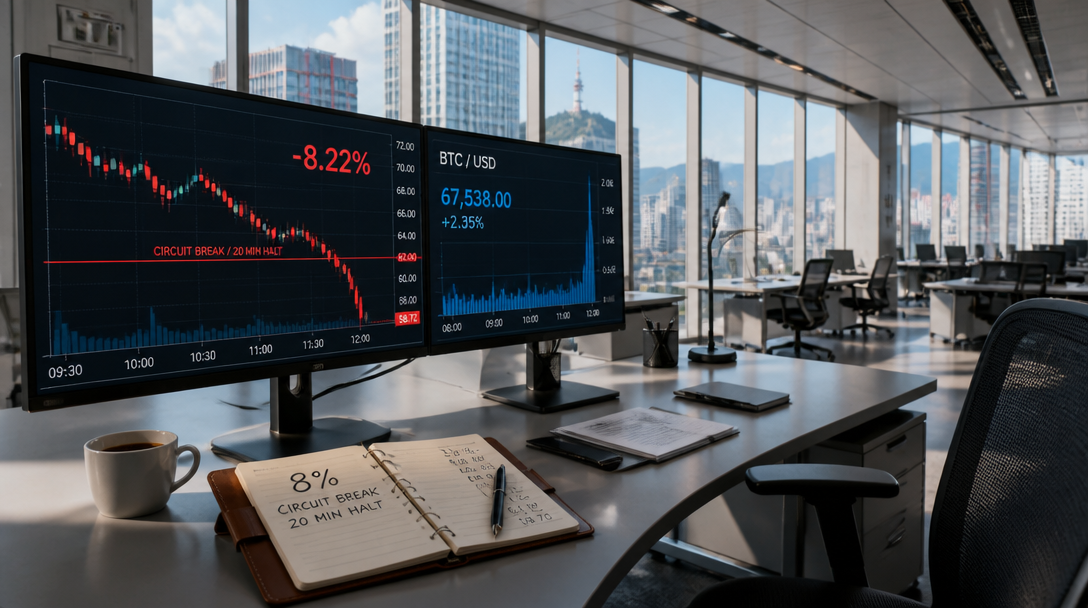
South Korea’s KOSPI stock index fell 8.22% on July 13, triggering a 20-minute trading halt under the exchange’s circuit-breaker rules. Yet trading volume on Upbit, the country’s largest crypto exchange, rose only modestly in response, offering scant evidence that equity investors pivoted durably into digital assets.
The KOSPI decline was driven by renewed Middle East tensions pushing oil prices higher and steep losses in Samsung Electronics and SK Hynix, which dominate Korea’s chip-heavy benchmark. Under Korea Exchange rules, a phase-one breaker activates if the KOSPI falls 8% or more from the previous close within one minute, pausing trading for 20 minutes but not redirecting investor capital.
Upbit volume rose to 8,379 BTC on July 13, a 12.67% jump from 7,436 BTC on July 12. The following day, volume increased further to 8,724 BTC, a 4.12% gain. However, both figures remained well below recent baselines. Current volume sits 27.38% below the 30-observation average of 12,014 BTC and 57% below the series high of 20,506 BTC recorded on June 26.
Evidence of a durable rotation would require Upbit volume to remain elevated across multiple observations after the shock and move above, not merely toward, recent baseline levels. The modest uptick on July 13 and 14 does not meet that threshold.
Margin Lending at Record Levels
The KOSPI’s vulnerability to sharp declines reflects elevated leverage in South Korea’s equity market. The combined average daily balance of margin and stock-backed loans reached 61.98 trillion won in the second quarter of 2026, up from 57.42 trillion won in the first quarter. This marks record margin lending levels, indicating a highly leveraged market prone to sharp reversals when sentiment shifts.
The modest crypto volume response suggests that even amid a sharp equity selloff, Korean investors did not treat crypto exchanges as a natural alternative to stock trading platforms during market stress. The July 13 KOSPI halt paused equity trading but did not redirect flows into crypto, and the subsequent volume increases on Upbit remained marginal relative to the scale of the stock index decline.
Frequently Asked Questions
How much did the KOSPI fall on July 13?
South Korea's KOSPI stock index fell 8.22% on July 13, triggering a 20-minute trading halt under the exchange's circuit-breaker rules.
Did the KOSPI crash trigger a crypto rotation on Upbit?
No. Upbit volume rose to 8,379 BTC on July 13, a 12.67% jump from 7,436 BTC, but stayed 27.38% below the 30-observation average of 12,014 BTC.
Why is South Korea's stock market prone to sharp declines?
Margin and stock-backed loans reached a record 61.98 trillion won in the second quarter of 2026, up from 57.42 trillion won, indicating a highly leveraged market.