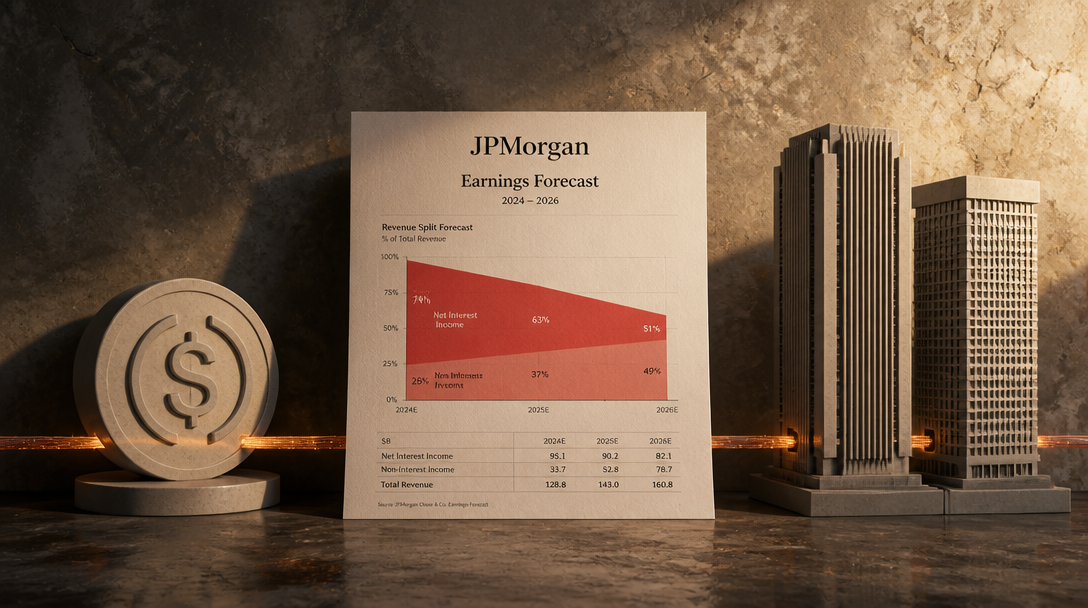
New revenue split creates near-term headwind, long-term threat to USDC economics
JPMorgan lowered earnings forecasts for Circle Internet and Coinbase on July 14, citing a revised distribution agreement with Hyperliquid that reshapes how USDC reserve revenue flows between the two partners.
Under the new arrangement, Coinbase classifies USDC held on Hyperliquid as “on-platform” and pays 90% of reserve income to Hyperliquid, a departure from the previous structure in which Coinbase split nearly all USDC reserve revenue evenly with Circle. The shift creates competitive pressure between Circle and Coinbase when promoting USDC distribution, according to JPMorgan analyst Kenneth Worthington.
“We think the change in the Hyperliquid relationship showcases the challenge for Circle and Coinbase partnership agreements because it can create ‘a prisoner’s dilemma’ that drive Coinbase and Circle to compete with each other when promoting USDC distribution,” Worthington said.
Hyperliquid has emerged as one of crypto’s fastest-growing trading venues. In July 2026, the decentralized perpetual futures exchange processed $150 billion in trading volume, equivalent to 11.5% of Binance’s volume. USDC holdings on Hyperliquid reached $6 billion, representing 8% of USDC’s circulating supply.
The timing compounds existing headwinds for stablecoin issuers. USDC circulating supply contracted from nearly $80 billion in March 2026 to approximately $73 billion, part of a broader $10 billion stablecoin market contraction that began in May.
JPMorgan characterized the Hyperliquid arrangement as a near-term revenue headwind for both companies, with a greater long-term threat to Circle’s USDC economics. The bank expects higher interest rates to provide support for USDC-related revenue over the longer term, though it did not specify the mechanism by which rate increases would benefit the stablecoin issuer.
Circle’s regulatory standing shifted in recent months with its OCC approval to establish First National Digital Currency Bank. Mizuho, a Japanese investment bank, called the milestone positive but cautioned that investors may be overestimating its significance.
The Hyperliquid-Coinbase-Circle arrangement underscores how rapidly growing trading venues can reshape stablecoin economics. Hyperliquid’s rise as a decentralized alternative to centralized perpetual futures exchanges has concentrated a material share of USDC supply on a single platform, creating leverage in negotiations over revenue sharing.
Circle CEO Jeremy Allaire has not publicly commented on the revised arrangement or its impact on the company’s revenue projections.
Frequently Asked Questions
Why did JPMorgan cut its forecasts for Circle and Coinbase?
JPMorgan lowered earnings forecasts on July 14, citing a revised distribution agreement with Hyperliquid that reshapes how USDC reserve revenue flows between the two partners.
How does the new Hyperliquid arrangement split USDC revenue?
Coinbase classifies USDC held on Hyperliquid as on-platform and pays 90% of reserve income to Hyperliquid, a departure from previously splitting nearly all reserve revenue evenly with Circle.
How much USDC is held on Hyperliquid?
USDC holdings on Hyperliquid reached $6 billion, representing 8% of USDC's circulating supply, after the venue processed $150 billion in July 2026 trading volume.