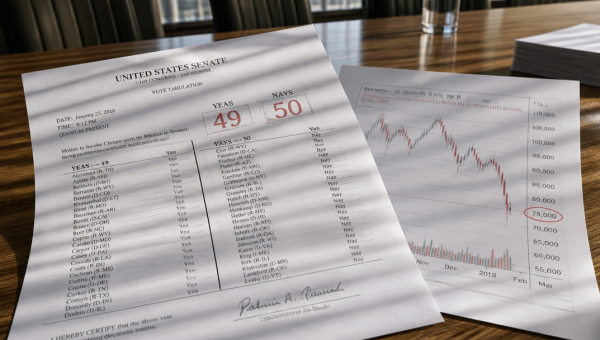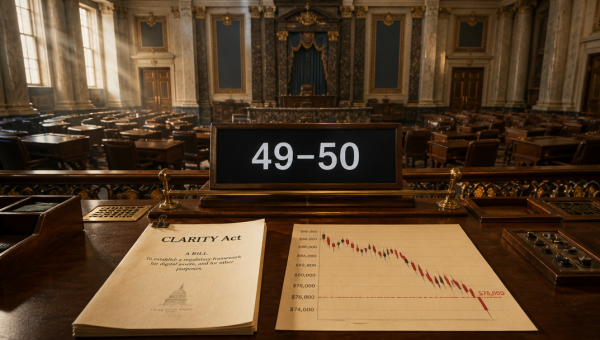
A coalition of 200+ crypto companies and groups sent a letter to Senate leaders on June 7 urging an immediate floor vote on the CLARITY Act, even as prediction markets sharply downgraded the bill’s chances of passage before August.
The letter, signed by Stand With Crypto, Blockchain Association, Crypto Council for Innovation, and The Digital Chamber, frames the bill as a competitiveness imperative. Without a federal framework, the coalition argues, digital asset activity will migrate to offshore jurisdictions with weaker consumer protections.
Senator Cynthia Lummis, the bill’s champion, posted on the same day that “the floor is next,” signaling urgency. She also warned against inaction, saying it would amount “to quit at the 5-yard line.” Tim Scott, Senate Banking Committee Chair, released a statement saying the bill “takes the side of everyday Americans” and would make crypto markets “safer, fairer, and more transparent.”
The Senate Banking Committee advanced the CLARITY Act on May 14 by a 15-9 bipartisan vote. The bill now awaits floor scheduling with no public timeline commitment from Senate leadership.
But prediction markets are pricing a different narrative. On June 3, Polymarket odds for 2026 passage stood at 62%. By June 8, that figure fell to 51%. More dramatically, Kalshi’s before-August contract collapsed from 39.7% on June 3 to 22.1% on June 8, a 17.6-point drop. Galaxy Digital analyst Alex Thorn revised his 2026 passage estimate downward from 75% to 60%.
The divergence between advocacy intensity and market conviction reflects structural headwinds. Per Davis Wright Tremaine legal analysis, the Senate Banking Committee substitute text must be reconciled with the Senate Agriculture Committee’s Digital Commodity Intermediaries Act before full Senate consideration. Any Senate-passed version must then align with the House-passed CLARITY Act.
Opposition has also hardened. On June 4, a coalition of consumer advocacy groups including the National Consumers League, Americans for Financial Reform, Consumer Federation of America, and Public Citizen sent a letter urging Senate leaders to oppose the Senate version. The groups cited three objections: weak Bank Secrecy Act and anti-money laundering requirements, insufficient ethics provisions, and a stablecoin-yield loophole. Democratic vote-counters and some moderate Republicans have flagged these provisions as needing revision.
The timing pressure is real. The EU’s MiCA transitional period expires July 1, after which crypto-asset service providers without a MiCA license must stop serving EU clients. A federal U.S. framework could ease compliance burdens for multinational operators.
Polymarket bulls price a 70% to 80% rebound if sentiment shifts. Kalshi before-August bulls target 40% to 55%. But bear cases drift toward 25% to 40% on Polymarket and 35% on Kalshi’s full-year contract, reflecting the legislative friction now visible in both chambers.