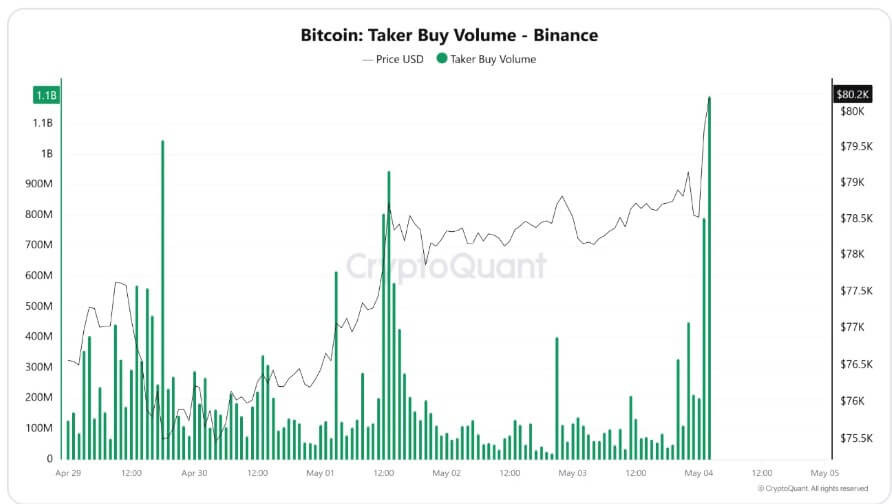
Bitcoin reclaimed $80,000 on May 4, marking its first visit to that level since February, but the $80,529 intraday high masks a fragile structure built on leveraged trades and macro volatility rather than sustained institutional demand. The move came after aggressive taker-buy surges on Binance totaling $1.98 billion across two hours, yet spot ETF inflows of $3.29 billion over two months signal the first durable accumulation since September-October 2025. Bulls are targeting $90,000 this week, but analysts warn that unless Bitcoin holds above $79,000 on a closing basis, the weekend surge was merely a liquidity grab designed to flush out late short sellers.
Taker Buys Drive Breakout, Not Organic Accumulation
Bitcoin’s move above $80,000 was driven by two sharp taker-buy surges on Binance rather than organic spot demand. The first surge injected $1.19 billion in taker-buy volume within a two-hour window, followed by a second burst of $792 million. This pattern signals aggressive market-maker participation but raises questions about sustainability. CryptoQuant analyst JA Maartunn flagged a critical structural test: Bitcoin must hold above $79,000 on a closing basis to maintain strength. If the asset loses that support, the breakout was merely a technical flush designed to clear out underwater shorts rather than a genuine shift in buyer sentiment. The Fear & Greed index dropped to 43 during the surge, indicating retail fear despite price gains—a classic divergence signal.
Spot ETF Inflows Break Nine-Month Dry Spell
US spot Bitcoin ETFs recorded $3.29 billion in net inflows over two consecutive months, the longest streak of consistent demand since the bear market began. Ecoinometrics data shows this nine-day inflow streak matches the pattern seen in October 2025, just before Bitcoin pushed toward its all-time high. The difference now is persistence rather than size. After October, ETF demand evaporated and the market rolled over. Deribit options data shows $1.7 billion in notional value clustered at $80,000 call strikes, with major targets at $90,000 and $100,000, suggesting institutional options positioning is betting on continuation. However, perpetual futures funding rates remain elevated at +0.51%, indicating leveraged traders are still long—a condition that can trigger sharp liquidations if macro headwinds intensify.
Fed Transition and Oil Prices Create Macro Overhang
Bitcoin’s $80K reclaim occurs amid significant policy uncertainty. Jerome Powell’s Federal Reserve term expires May 15, with Kevin Warsh’s confirmation vote expected in the week of May 11. Barclays forecasts zero Fed rate cuts for 2026, signaling a prolonged high-rate environment that pressures risk assets. Oil prices remain elevated above $100 per barrel due to Middle East tensions, sticking inflation expectations and forcing central banks to maintain hawkish stances. This macro backdrop creates a ceiling for Bitcoin’s upside. The $90,000 target that bulls are chasing this week faces headwinds from policy uncertainty and geopolitical risk premiums that can reverse quickly if tensions ease or inflation data surprises to the downside.
Structural Support Fragile Until $79K Holds
The immediate test for Bitcoin’s breakout is the $79,000 support level. Analysts argue that holding this zone on a closing basis would confirm the ETF inflows are creating durable structural support rather than a short-squeeze bounce. Current price action at $79,621 at press time leaves little margin for error. If Bitcoin closes below $79,000, the taker-buy surge loses credibility as evidence of institutional demand and instead confirms it was a tactical move to liquidate short positions. The $90,000 target remains within reach if macro conditions stabilize and Fed confirmation processes unfold without major shocks, but the asset is vulnerable to a rapid pullback if leverage unwinds.