Crypto markets function as 24/7 price discovery venue while traditional markets close over weekend geopolitical escalation
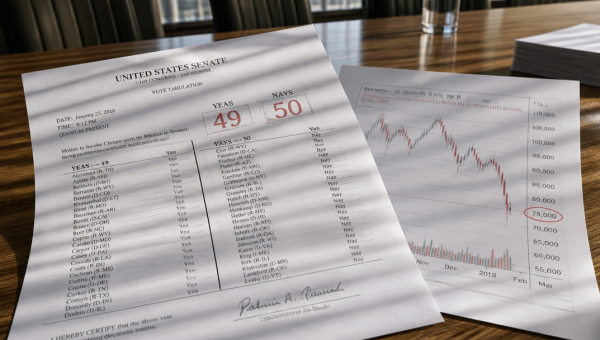
Bitcoin briefly recovered to the $74,000 level on May 29 after U.S. President Donald Trump tied a claimed Iran deal to reopening the Strait of Hormuz, even as Iran disputed the agreement’s finalization. The move underscored crypto’s role as a continuous price discovery mechanism for macro geopolitical signals when traditional markets are offline.
Trump said he would make a “final determination” on an Iran deal requiring Hormuz reopening with mines removed and tolls prohibited. Iran responded that the agreement had not been finalized and that Trump’s account was partly inaccurate. CME crude, U.S. equities, ETF flows, and Treasury markets are either closed or less active over the weekend, leaving traders to express Hormuz risk through Bitcoin and 24/7 oil perpetuals on venues such as Hyperliquid.
The Strait of Hormuz carried 20 million barrels per day of oil flows in 2024, representing 20% of global petroleum liquids consumption and 25% of global seaborne oil trade in 2025. Middle East crude exports collapsed from 18.3 million barrels per day before the crisis to 8.8 million barrels per day since March. The International Energy Agency called Hormuz resumption the “single most important variable” for global energy supply and price relief in its April Oil Market Report. Analysts have lifted 2026 Brent forecasts to $90.44 per barrel for a third consecutive time.
Bitcoin’s weekend price action reflected broader weakness in spot ETF demand. The 11 U.S. spot Bitcoin ETFs lost more than $2 billion over the past two weeks. On May 27, net Bitcoin ETF outflows reached $733.4 million. On May 28, outflows totaled $223.3 million. BlackRock’s IBIT shed $527.84 million on Wednesday, marking the second-largest outflow since the fund’s launch.
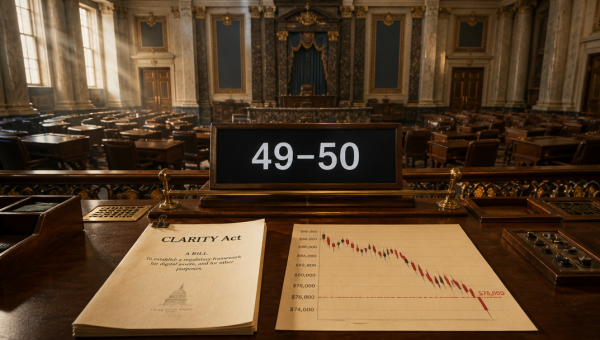
Options markets showed heightened hedging activity. Roughly $6.25 billion in Bitcoin options expired on Deribit on May 29, with $75,000 representing max pain for call holders and $72,500 serving as a key support level. Bitcoin’s weekend volume has deteriorated significantly since U.S. spot ETF launches, falling to an all-time low share of 16% versus 28% in 2019. During weekends, spot Bitcoin continues trading but in a thinner book with fewer arbitrageurs, creating wider cross-exchange price dispersion.
In January 2026, cross-exchange price dispersion on XRP spiked to 18 basis points during weekend liquidity deterioration, compared to a typical weekday spread of 5 basis points. On Saturday, Bitcoin dropped 6% from the $73,500 reference level, implying a move toward $69,000. The $67,000 to $69,000 range represented Bitcoin’s last major floor before ETF-driven recovery, with upside targets at $78,000 and $80,000 aligned with large call concentrations on Deribit. The next structural reference below $72,500 sits at $71,000, with $70,000 serving as a round-number sentiment line.
Early-April shipments through Hormuz had fallen to 3.8 million barrels per day, down from over 20 million barrels per day in February, illustrating the scale of supply disruption. Traders monitoring both energy and crypto markets are watching whether Trump’s claim gains traction in traditional markets when they reopen, or whether Iran’s dispute signals further escalation.