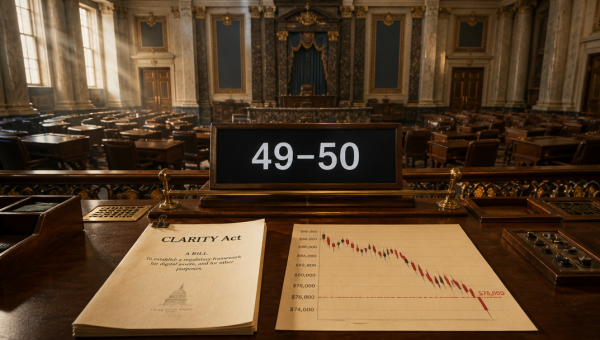
President Donald Trump has re-entered the U.S. crypto market-structure debate, publicly endorsing the CLARITY Act on May 27, 2026, as the Senate bill moves toward a floor vote following committee approval earlier this month.
In a Truth Social post, Trump said his administration will “codify a FUTURE-PROOF Digital Asset Market Structure that cannot be undone by the Crypto Haters.” He attributed the shift in crypto policy to his leadership, stating that “Gary Gensler and the ‘Anti-Crypto Army’ nearly DESTROYED the American Crypto Industry by driving Bitcoin, Crypto Perpetuals, and INNOVATION offshore, but ‘TRUMP’ SAVED IT.”
The CLARITY Act advanced out of the Senate Banking Committee on May 14, 2026, in a 15–9 vote. The House passed its version in July 2025 by a 294–134 margin. The Senate version would establish regulatory boundaries for digital assets, exchanges, custodians, stablecoins and derivatives markets, creating a category for ancillary assets and introducing a “Regulation Crypto” exemption from SEC registration for certain ancillary asset offerings.
Trump’s endorsement marks his second public intervention on market structure in 2026. He last weighed in on the issue in March 2026. His position aligns with his administration’s broader crypto agenda, which began with an executive order on January 23, 2025, calling for support for digital asset growth. In July 2025, the White House released a digital asset working group report recommending Congress give the CFTC authority over spot markets for non-security digital assets while directing the SEC and CFTC to clarify rules for registration, custody, trading and recordkeeping.
Trump also signed the GENIUS Act into law on July 18, 2025, establishing a stablecoin framework requiring 100% reserve backing with liquid assets, monthly public reserve disclosures, marketing restrictions and priority claims for stablecoin holders in insolvency.
CFTC Chairman Mike Selig echoed Trump’s framing, posting that “Thanks to @POTUS’ leadership, America is the Crypto Capital of the World. Bitcoin, Crypto Perpetuals, and INNOVATION are Coming to America.”
The Senate Banking Committee’s 15–9 vote included support from two Democrats, though those members did not commit to backing the final bill. The CLARITY Act would treat digital commodity brokers, dealers and exchanges as financial institutions under the Bank Secrecy Act, requiring initial and semiannual disclosures for certain transactions.
The bill has faced criticism from multiple quarters. Consumer advocates have argued that AML provisions are too weak. Some have called for restrictions preventing political officials from profiting from crypto ventures. Bank groups have warned that crypto firms could compete for deposits through rewards on stablecoin balances, raising financial stability concerns. Critics have also questioned whether expanded CFTC authority fully addresses investor-protection concerns traditionally handled by the SEC.
The crypto market cap stood at $2.43 trillion at press time, reflecting broader institutional and retail adoption since the shift in regulatory posture.