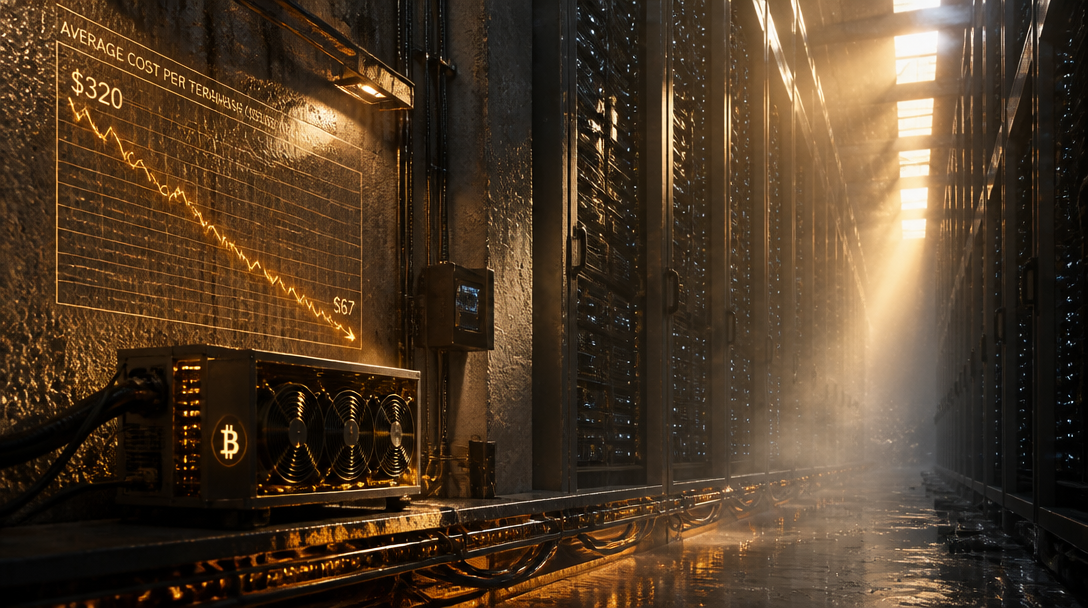
The estimated cost of building a quantum-resistant Bitcoin transaction has fallen from $320 to $67 in a single week, after developers and AI models competed to optimize the computational overhead in an open challenge organized by StarkWare, Yukon Research, and Eigen Labs.
The optimization targets the most expensive part of quantum-safe transaction construction: a brute-force search that runs on a user’s own GPU before the transaction reaches the blockchain. The process requires repeated hashing until one matches a required shape. The initial quantum-safe Bitcoin transaction, mined on mainnet a month ago, required approximately 3,100 GPU-hours and an estimated $320 in compute cost.
The Quantum-Safe Bitcoin Optimization Challenge invited developers and AI models, including Anthropic’s Opus 5, Fable 5.1, OpenAI’s GPT-6 Astra, Grok 4.6, and Kimi, to reduce that overhead. Sixty-two improvements were promoted across two competition tracks.
The optimization increased throughput on a standard RTX 4090 GPU from 146 million verified candidates per second to 820 million after one week. That efficiency gain directly reduced the estimated compute bill for a single quantum-safe transaction.
StarkWare emphasized that “the $67 is an estimate, not a price,” and shifts each time a solver beats the record. The figure assumes stated hardware conditions and does not represent a market transaction cost.
Quantum-safe transactions protect coins by replacing a signature with a hash, avoiding the need for a network-wide Bitcoin fork. The construction only shields coins whose public key has not already been exposed. Because these transactions are nonstandard, they must be sent directly to a miner rather than broadcast across the network like standard transactions.
Finding a valid hash requires searching through approximately one in 70 trillion possible outputs. The optimization challenge reduced the time and energy required to perform that search on consumer hardware.
StarkWare noted that “the work doesn’t make Bitcoin quantum-safe on its own—it still favors a soft fork long-term.” The company maintains that a protocol-level change remains the better long-term approach to protecting all Bitcoin holders against the hypothetical point, known as “Q-Day,” when quantum computers could break the elliptic-curve cryptography securing wallets.
Coinbase has begun drafting post-quantum custody playbooks as institutions prepare for quantum threats to digital asset security.