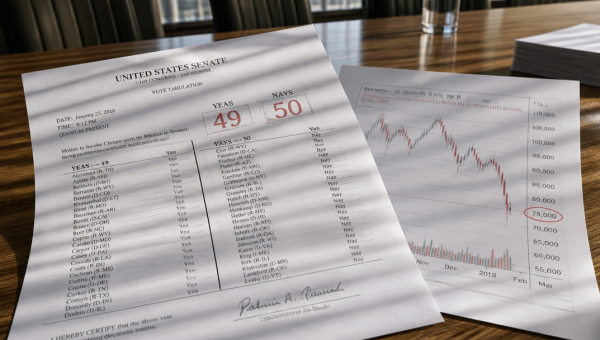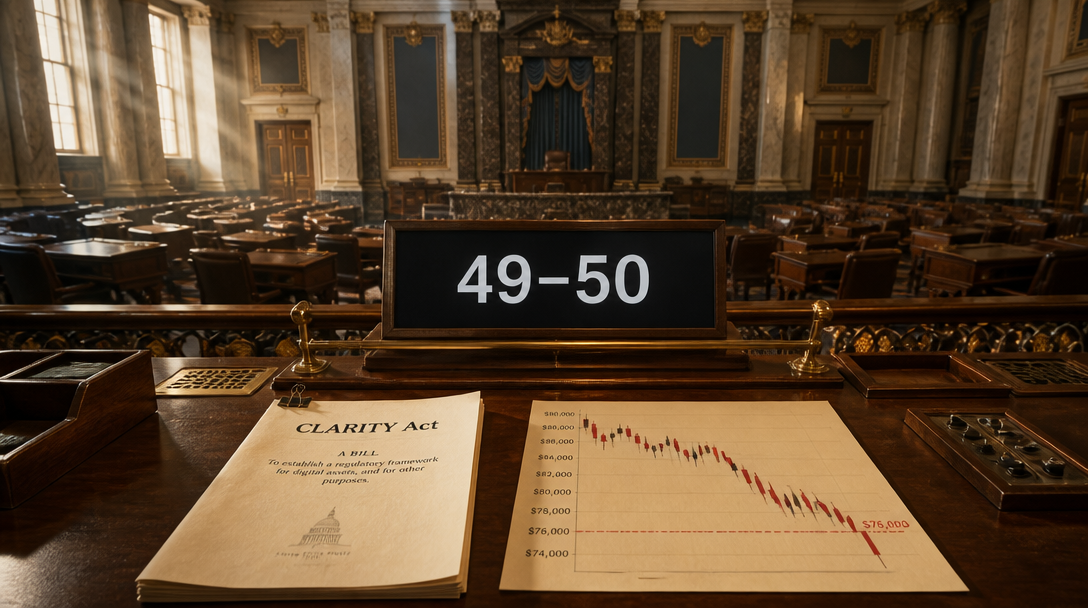
The US Senate failed to advance the Digital Asset Market Clarity Act on September 15, falling short of the 60-vote supermajority required to proceed to debate. The cloture motion received 49-50 votes, leaving the proposal 11 votes short of the threshold needed to move forward.
The CLARITY Act was designed to replace the crypto industry’s fragmented regulatory environment with uniform federal rules for issuing, trading, and selling digital assets. The rejection stalls efforts to establish a comprehensive federal framework governing digital asset markets.
Bitcoin declined sharply on the day, hitting an intraday low of $74,967.97 and falling below the $76,000 level. However, the price decline began before the Senate vote, indicating the legislative outcome was one factor in afternoon weakness but not the sole driver of the full-day decline. Pressure from Federal Reserve monetary decisions also weighed on risk assets during the period.
The altcoin market cap fell 3.6% during the same window, dropping to a floor of $1.15 trillion. Liquidations accelerated following the vote: over $300 million in liquidations were registered within 20 minutes of the cloture motion, with 24-hour liquidations exceeding $665 million, according to data from CoinGlass, a cryptocurrency derivative analysis platform.
The Senate did not specify whether the CLARITY Act will be reintroduced or on what timeline. The source material reviewed did not name individual senators’ positions on the vote or identify which party or coalition led the rejection.