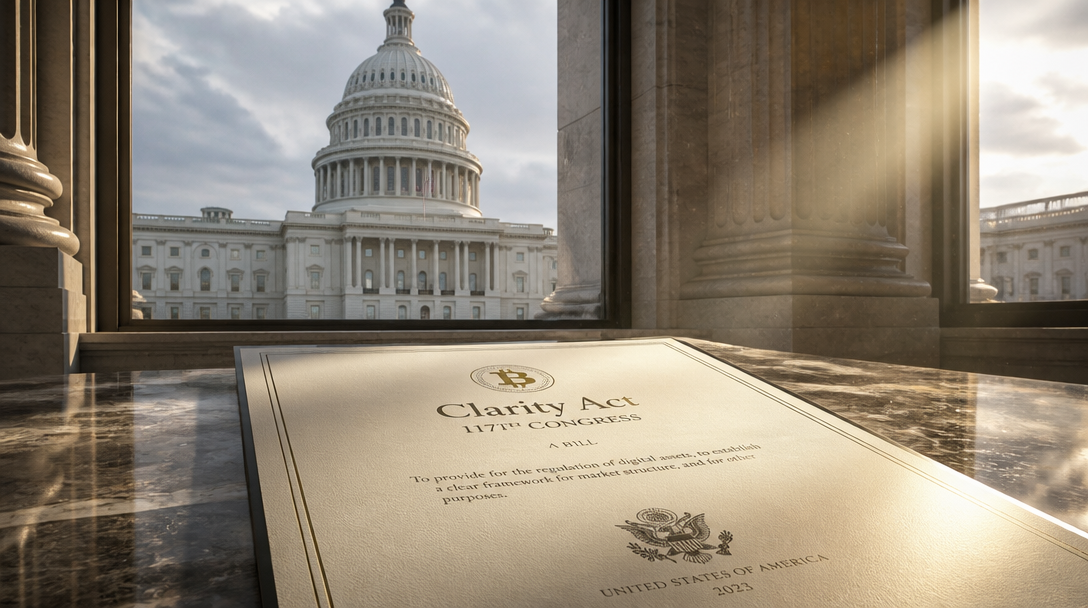
SEC Commissioner Hester Peirce said she expects the Clarity Act to pass the Senate this summer, signaling momentum for legislation that would establish the first federal framework for spot crypto markets and divide digital asset oversight between the SEC and the Commodity Futures Trading Commission.
Peirce made the statement during an appearance on the Searching for Mana podcast, according to reporting by Micah Zimmerman in Bitcoin Magazine. The bill has already cleared the House and now awaits Senate action as part of the Trump administration’s broader crypto regulatory agenda.
“This is a rare window where you have a lot of regulatory goodwill. Use that to build things that last, things that matter,” Peirce said.
The Clarity Act would clarify how the Howey Test applies to token classification, a distinction that has created legal ambiguity for crypto projects. The bill would also shield developers from liability when others misuse their tools, addressing a long-standing concern among builders in the sector.
SEC Chair Paul Atkins reinforced the administration’s commitment to crypto oversight during a separate appearance on Fox News, where he was interviewed by Larry Kudlow. Atkins framed the prior administration’s approach to digital assets as fundamentally skeptical.
“America was an investment before it was a nation,” Atkins said, contrasting the current regulatory posture with what he characterized as past hostility toward the sector.
Atkins did not detail specific reforms beyond his remarks on regulatory direction, according to the available reporting. The administration has also advanced Trump Accounts, a version of a traditional IRA designed to appeal to retail investors, with 6 million children enrolled and $1,000 deposits set for those born in the next two years. The first Trump Accounts are scheduled to launch on July 4, 2026.
Peirce’s tenure at the SEC is nearing its end. She is set to depart for a law school teaching position, though the specific institution has not been disclosed.
The Clarity Act represents a shift in federal posture toward digital assets. Current law does not establish a federal structure for spot crypto markets, leaving regulatory authority fragmented across state and federal agencies. The bill would create a unified framework under SEC and CFTC jurisdiction, reducing the compliance burden for exchanges and projects operating across multiple jurisdictions.
Token classification under the Howey Test has been a source of litigation and regulatory uncertainty since the SEC began applying the 1946 Supreme Court standard to digital assets. The Clarity Act would codify standards that currently exist only in enforcement actions and guidance documents, providing legal certainty for issuers and platforms.
Developer liability protection in the bill addresses concerns that creators of open-source tools or protocols could face civil or criminal liability for downstream misuse. The provision has support from both crypto advocates and some traditional tech industry figures who argue that liability shields are standard for software creators.
Atkins’ appearance on Fox News, conducted by Kudlow, underscores the administration’s public commitment to reframing crypto policy. The messaging aligns with statements from Peirce and reflects a deliberate effort to signal to the sector that the regulatory environment has shifted.