UK regulator replaces individual holding restrictions with product-level ceiling
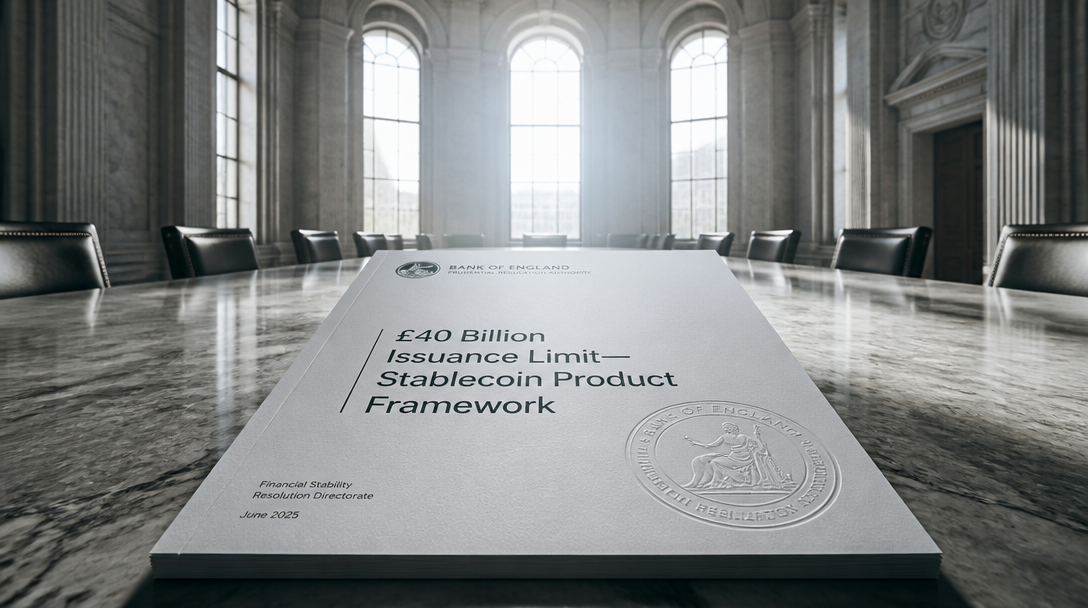
The Bank of England abandoned proposed individual wallet caps for sterling stablecoins on June 22, 2026. It replaced them with a temporary £40 billion issuance limit per systemic stablecoin product. The change came in a policy statement and draft Code of Practice released that day.
The shift marks a reversal from November 2025, when the Bank proposed per-coin holding limits of £20,000 for individuals and £10 million for businesses. Those restrictions drew criticism from the House of Lords Financial Services Regulation Committee. The committee issued a report on June 3, 2026, pressing the Bank to reconsider the caps alongside other backing-asset requirements.
Under the new framework, the £40 billion ceiling applies only to products recognized as systemic and entering the Bank’s regulatory regime. It does not apply automatically to all stablecoin sandbox tests run by the Financial Conduct Authority. The guardrail is designed as a transitional measure to mitigate risks to credit provision, according to the Bank’s analytical framework.
Reserve Rules Eased for Issuers
The Bank also relaxed backing-asset composition rules. The allowable share of interest-bearing securities in reserve assets rose from 60% to 70%. The required share of unremunerated central bank deposits fell from 40% to 30%. This adjustment is intended to improve yield on backing assets and reduce the cost of compliance for issuers.
The Bank acknowledged a trade-off inherent in the product-level cap: if demand for a systemic stablecoin exceeds the capped supply, the token could trade above par in secondary markets. “The Bank expects to review, loosen, and ultimately remove the cap once it is satisfied those risks have been addressed,” according to the policy statement.
Four firms are currently testing stablecoin services in the FCA’s sandbox cohort: Monee, ReStabilise, Revolut, and VVTX. The draft rules consultation closes on September 22, 2026. The Code of Practice is intended to be finalized by year-end. Regulated stablecoins are expected to operate in the UK by 2027.
The House of Lords had urged the Bank to reconsider more than holding limits. It also flagged restrictions on commercial banks issuing stablecoins and the requirement for unremunerated backing-asset holdings. The Bank’s June statement did not address the commercial-bank-issuance question. Nor did it fully eliminate the non-yielding central-bank-deposit requirement, leaving those issues unresolved.
Market context
Sterling stablecoins remain a small fraction of the global stablecoin market. USDT holds a market capitalization of $186 billion, while USDC stands at $74 billion. The £40 billion cap is equivalent to approximately $53 billion. If fully utilized, it would position a systemic sterling stablecoin among the largest in the world.