Bipartisan bill aims to establish U.S. crypto rules as banking groups push back
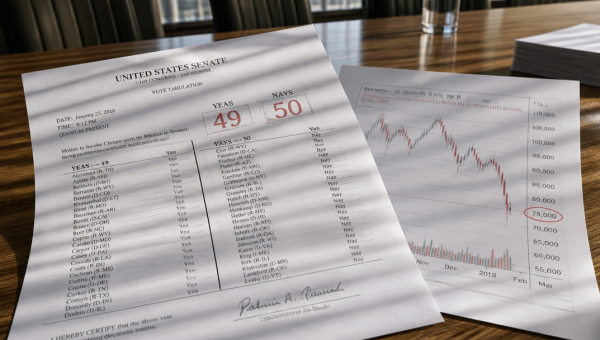
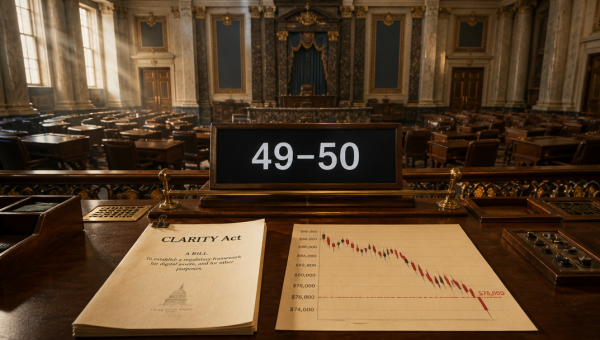
The U.S. Senate Banking Committee has advanced the Digital Asset Market CLARITY Act, legislation that would establish the first comprehensive regulatory framework for digital assets in the United States. The move marks a significant step after months of bipartisan negotiation between banking interests and fintech companies.
The compromise, brokered by Senators Thom Tillis (R-NC) and Angela Alsobrooks (D-MD), permits consumer rewards and bonuses tied to stablecoins while preventing stablecoins from being classified as interest-bearing accounts. Banking lobby groups are now seeking tighter restrictions on these consumer incentives, despite the deal’s passage through committee.
“The little guy is getting lost in the political horse-trading around the CLARITY Act,” said Alex Tapscott, CEO of CMCC Global Capital Markets. Tapscott noted that the stakes for American consumers are substantial. Roughly one in five American adults own cryptocurrency, and 80% of merchants believe accepting crypto could help attract new customers. Among small business owners, 73% expect crypto payments to grow.
The resistance from banking groups underscores a deeper tension. Stablecoins enable cheaper remittance costs, faster payments, and new savings mechanisms that could compete with traditional banking services. Meanwhile, the broader crypto sector faces structural challenges. U.S. developers have declined from 38% to 19% of global crypto developers over the past decade, while 88% of global crypto trading volume occurs on non-U.S. exchanges and 75% of stablecoin volume comes from foreign-issued tokens.
Aisha Hunt, founder of Kelley Hunt, PLLC, frames crypto’s evolution differently. “Crypto spent its first decade trying to replace Wall Street. Its next trillion dollars may come from partnering with it,” Hunt said. She added that tokenization of traditional finance assets represents a critical inflection point: “That is usually when real adoption begins.”
That partnership is already taking shape. On January 21, 2026, F/m Investments LLC and The RBB Fund, Inc. filed an exemptive application with the SEC to tokenize TBIL, a U.S. Treasury 3 Month Bill ETF, on a permissioned blockchain. The application preserves the existing fund structure and regulatory framework while enabling tokenization. The SEC decision remains pending.
Consumer protection remains a central concern. According to Consumer Financial Protection Bureau data, Americans paid $5.8 billion in overdraft fees in 2023, with 80% of those fees concentrated among just 9% of accounts. Tapscott emphasized that consumers have clear expectations: “Consumers want financial services to move faster, cost less and earn them more.”
The tension between these interests will likely shape the CLARITY Act’s path through the full Senate. Banking groups’ push for tighter restrictions could delay or dilute a bill designed to bring regulatory clarity to an industry that currently operates in legal gray zones across much of the United States.