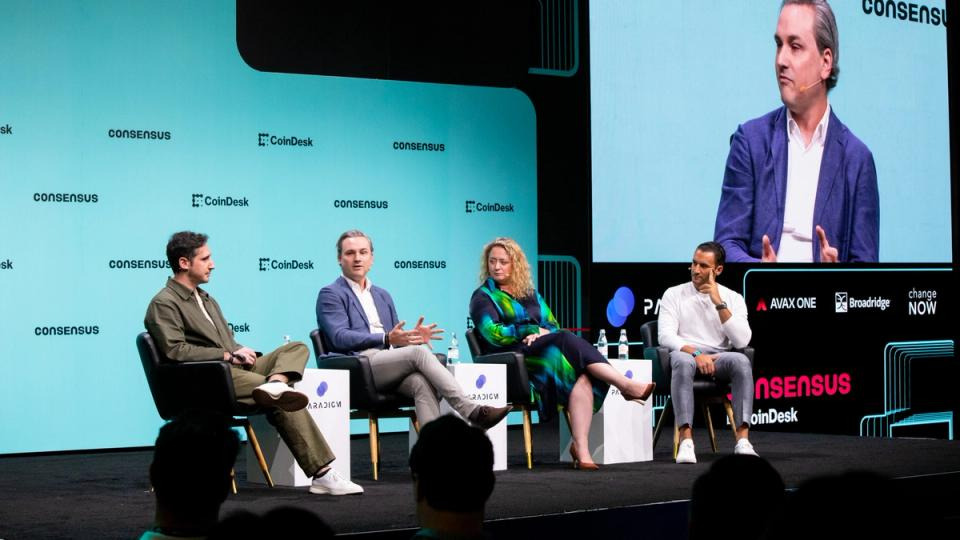
Executives from Ondo Finance, Robinhood, and Babylon Labs said at Consensus Miami 2026 that traditional finance firms are moving past blockchain education into active product deployment, though institutional adoption remains constrained by regulatory uncertainty and technical complexity.
The panel discussion, held in May 2026, revealed a fundamental shift in Wall Street conversations. Banks are no longer asking whether to integrate crypto infrastructure. They are asking how to build it. Ian De Bode, Ondo President, stated: “I think it’s very clear that Wall Street is coming to crypto.” Nicola White, an executive at Robinhood and its subsidiary Bitstamp, reinforced this: “We’re not having conversations anymore about what blockchain is. Now it’s about, how do we help them build?”
From Education to Implementation
Over the past two years, the nature of conversations between crypto firms and traditional finance has shifted materially. Banks that once sought basic blockchain education now request technical assistance for tokenized securities, stablecoin products, and blockchain-based settlement systems. White noted the breadth of interest: “There’s not a traditional finance Wall Street company we’ve talked to that has said this isn’t something they’re thinking about.” De Bode added context on specific use cases. Ondo’s tokenized treasury products enable weekend minting and redemption, plus daily yield generation unavailable in conventional money markets. This capability alone represents a structural advantage over traditional settlement windows.
Tokenized Assets and Blockchain Settlement
Institutional interest centers on three primary areas: tokenized securities, stablecoin infrastructure, and 24/7 settlement. Babylon Labs, which offers bitcoin-backed lending without requiring custody transfer, represents another model gaining traction. The tokenization trend extends to partnerships with established financial infrastructure. Robinhood’s integration of crypto trading with traditional brokerage services, combined with DTCC and Broadridge involvement, signals that legacy clearinghouses are actively preparing blockchain-native settlement systems. De Bode acknowledged the structural appeal: “That in and of itself as a value prop is mind-blowing to many in TradFi.” Weekend and 24/7 operational capability alone justifies institutional evaluation.
Regulatory Uncertainty Remains the Bottleneck
Despite evident interest, regulatory clarity remains absent. Panelists acknowledged that U.S. regulatory guidance has not materialized at the pace required for mass institutional deployment. De Bode offered a candid assessment of the outcome: “I don’t see a world in which everything that happens offshore finds a home in the U.S.” This suggests a two-track future: regulated domestic systems moving cautiously, and permissionless offshore DeFi advancing without institutional participation. The gap between Wall Street readiness and regulatory permission is widening, not closing.
Next Phase: Execution and Compliance
The question now shifts from theoretical adoption to operational deployment. Institutional firms have moved from exploration to integration timelines. However, without explicit regulatory frameworks for tokenized securities and blockchain settlement in the U.S., large-scale adoption will likely remain incremental. Offshore venues and international jurisdictions may absorb institutional crypto activity faster than domestic markets. The conversation at Consensus Miami confirmed demand exists. Execution and compliance approval remain uncertain.