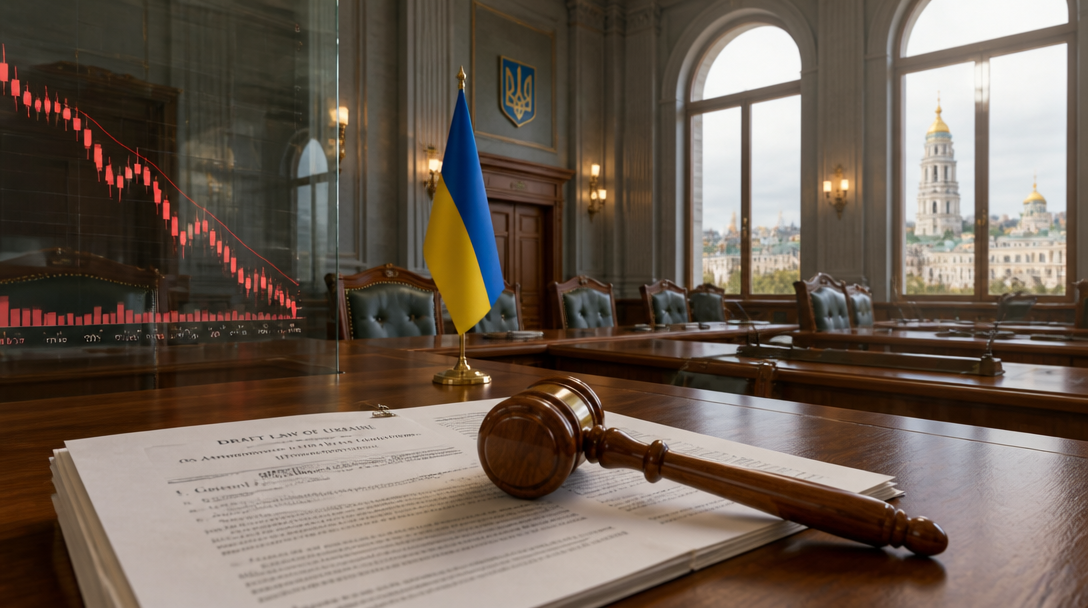
Ukraine’s National Bank will not support Draft Law No. 10225-d on virtual assets, the central bank announced November 4 after a parliamentary committee voted to recommend the bill for final floor debate. The NBU cited inadequate supervision of foreign tokens that function as electronic money and said the draft risks monetary sovereignty.
The Verkhovna Rada Committee on Finance, Tax and Customs Policy cleared the bill for second reading on the same day. A final vote by the full parliament is expected later in November. If adopted, the rules would take effect July 1, 2027.
Ukraine legalized its virtual-asset framework in 2022. The new bill aims to establish detailed rules modeled on the EU’s Markets in Crypto-Assets regulation (MiCA) and recommendations from the International Monetary Fund. The NBU said it supports that direction in principle but found the committee process inadequate.
“The development of the virtual asset market and the protection of monetary and financial stability are not mutually exclusive,” the National Bank of Ukraine said in a statement. The central bank added that the process “was not sufficiently transparent.”
Deputy Governor Oleksii Shaban raised objections during the committee meeting but said the format did not allow full debate. The NBU’s chief concern is that foreign tokens acting as electronic money would escape central-bank oversight. Under the bill, supervision would split between the NBU and the National Securities and Stock Market Commission if adopted.
The bill includes a 5% reduced personal income tax rate on virtual-asset trades through the end of 2028. It caps trading-platform operators at three legal persons in an initial wave, a compromise the NBU initially opposed before agreeing to the figure. The final draft reportedly drops a five-year sunset on that cap and leaves discretion to the securities commission without antitrust safeguards.
A separate bill introduced last year would permit the NBU to hold bitcoin and other digital assets in its foreign-exchange and gold reserves, though such holdings would not be mandatory.