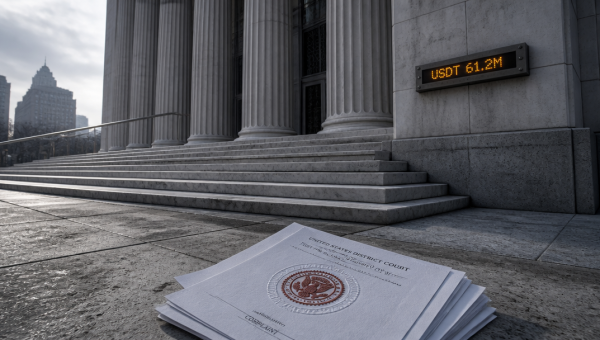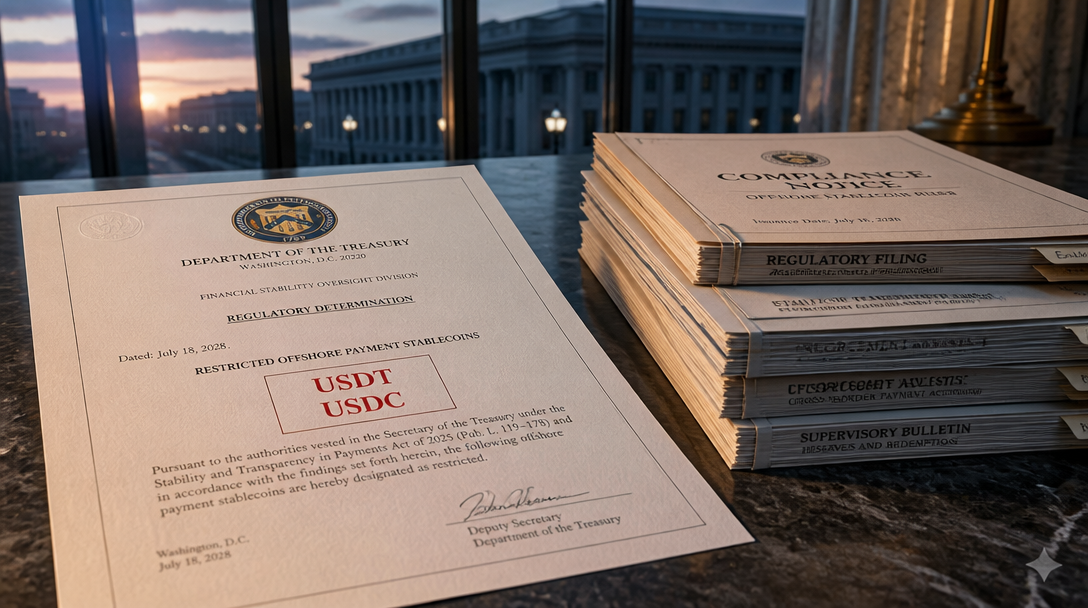
The US Treasury Department has proposed rules under the GENIUS Act that would prohibit domestic digital asset service providers from offering offshore payment stablecoins to US customers after July 18, 2028, unless the issuer qualifies under permitted categories.
The proposal creates a two-phase compliance timeline. On January 18, 2027, the broader GENIUS regime takes effect, requiring companies to cease issuing payment stablecoins in the US without entering the regulatory framework. US service providers carrying foreign-issued tokens face initial conditions at that date. Eighteen months later, on July 18, 2028, the wider rule activates, allowing covered providers to carry only tokens from permitted issuers or qualifying foreign issuers.
Tether’s USDT, the largest offshore stablecoin by market cap at $183.0 billion as of August 21, would be directly affected. USDT is currently available to US customers through Coinbase and Kraken. Circle’s USDC, with a market cap of $73.3 billion, and Paxos Trust Company’s PayPal USD (PYUSD), at $2.9 billion, are issued by domestic entities and would not face the same restrictions.
Tether operates from El Salvador and holds digital asset and stablecoin issuer licenses there. The company has demonstrated ability to freeze addresses while working with US authorities. Tether launched USA₮ as a federally regulated dollar stablecoin in January, though the year was not specified in available materials.
Foreign Issuer Pathway
Under Section 18 of GENIUS, foreign issuers can access the US market if their home country operates a comparable stablecoin regime and the issuer registers with the Office of the Comptroller of the Currency (OCC). The Treasury proposal does not specify which regimes qualify as comparable or which issuer categories meet the permitted standard.
Treasury is also soliciting public comment on whether exchanges’ due diligence should include examining foreign issuers’ smart contracts to confirm their ability to seize, freeze, or burn tokens when legally required. The public comment period closes on October 19.
Scope and Exemptions
The proposal controls how regulated businesses distribute tokens inside the US. It does not ban offshore tokens from circulating abroad or moving between private wallets. Self-custody remains excluded from the GENIUS framework, meaning individuals can hold offshore stablecoins in non-custodial wallets without restriction.
Stablecoins can settle across multiple exchanges and blockchains at any hour, creating operational complexity for compliance. The Treasury proposal does not address other major stablecoins such as DAI or FRAX, and does not clarify specific implementation details for all affected issuers.