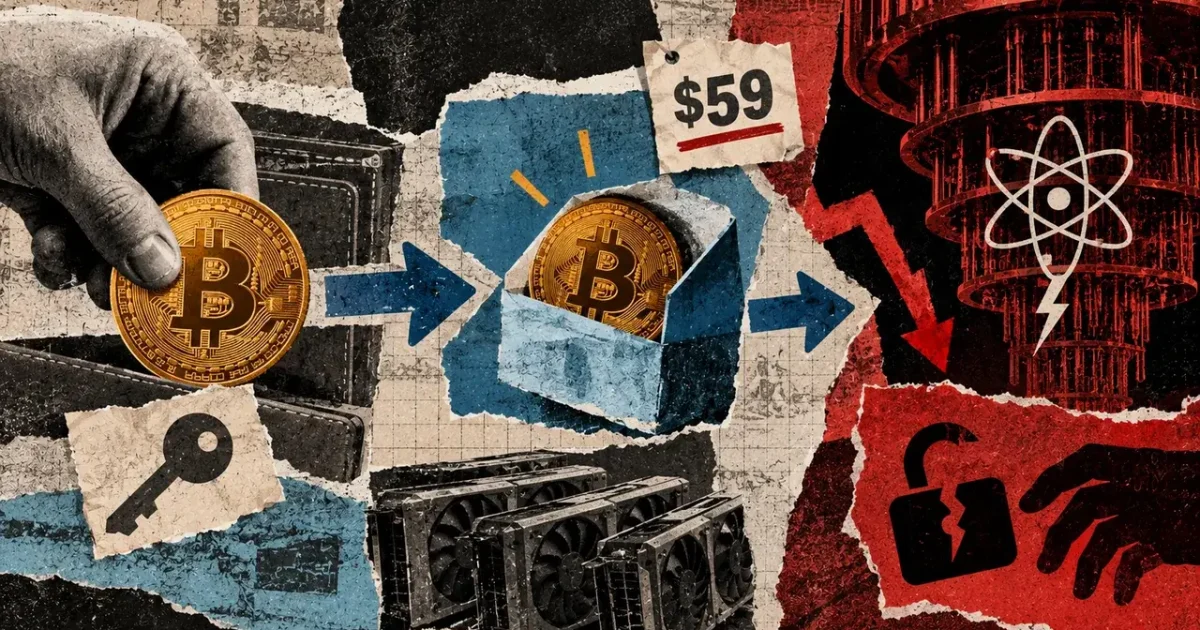
Researchers have reduced the estimated computing cost of a quantum-safe Bitcoin transaction by 82 percent to $59, according to results from a public optimization challenge organized by StarkWare, Yukon Research, and Eigen Labs.
The figure represents a dramatic compression from the August 2024 mainnet demonstration, when the estimated cost stood at $320. A September update had already narrowed it to $67. The latest optimization, completed on October 13, 2024, relies on improved GPU software and AI-assisted coding tools applied to Nvidia hardware.
Avihu Levy, a StarkWare researcher, contributed to the effort. The $59 estimate is hardware-dependent and based on simulated GPU workloads rather than a completed production transaction. Bitcoin network fees are separate from this figure.
The Quantum Threat and QSB Method
In March 2024, Google Quantum AI reported that future quantum computers could break elliptic-curve cryptography used by Bitcoin with substantially fewer resources than previously estimated. The discovery prompted research into quantum-safe alternatives.
Quantum-Safe Bitcoin (QSB) uses hash-based cryptography and computational puzzles to secure specially prepared Bitcoin holdings against attacks on conventional digital signatures. The method allows holders to perform required calculations off-chain before spending coins.
QSB transactions comply with Bitcoin’s consensus rules but ordinary network relay policies reject them, requiring direct submission to miners willing to process them. MARA, a North American Bitcoin miner, provided miner access through its Slipstream service during the August demonstration.
Vulnerability and Scope
Current estimates indicate 6.04 million BTC carry exposed public keys, representing 30.2 percent of Bitcoin’s issued supply. Of this total, 1.92 million BTC are exposed through underlying address structures, and 4.12 million BTC are exposed through address reuse and previous spending activity.
QSB protects only eligible coins whose conventional public keys remain hidden until moved into specially constructed outputs. Already-exposed holdings remain vulnerable if a capable quantum attacker emerges before owners complete secure migration.
Technical Performance and Targets
The optimization achieved 1 billion verified candidates per second on Nvidia RTX 4090 GPU hardware, up from an initial rate of 146 million candidates per second. Theoretical quantum attacks could require approximately 500,000 physical qubits, a 20-fold reduction from earlier estimates.
Researchers are targeting a computing cost below $10. StarkWare continues to favor a broader Bitcoin protocol upgrade for long-term protection against quantum threats.
The $59 estimate remains untested in complete transactions and relies on provisional assumptions for some computing stages.