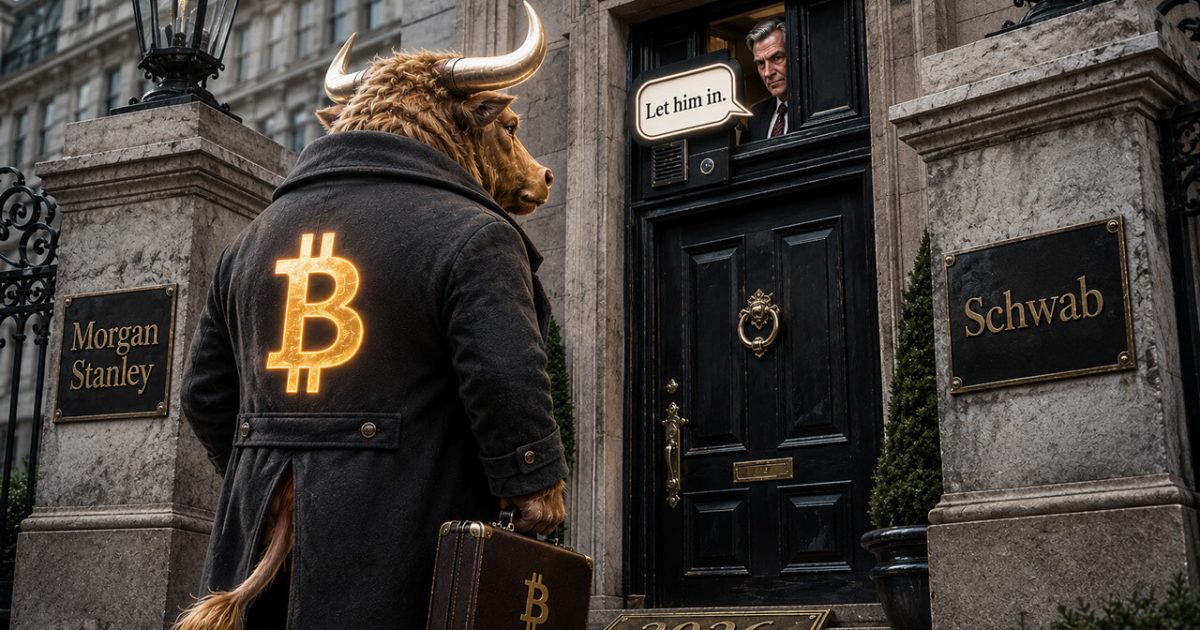
Morgan Stanley and Charles Schwab are moving to internalize crypto trading within their brokerage platforms, ending a two-year split where client Bitcoin and Ethereum exposure flowed through external exchanges like Coinbase and Robinhood. Both firms are building infrastructure during a market slowdown, capitalizing on regulatory clarity from the FDIC, OCC, and SEC to launch direct trading before anticipated retail demand returns. Morgan Stanley’s E*Trade platform targets a first-half 2026 launch via Zerohash execution, while Schwab has already begun a phased rollout with Paxos, starting with Bitcoin and Ethereum.
Regulatory Clarity Unlocks Bank Crypto Infrastructure
Three regulatory decisions in 2025 and 2026 removed barriers to bank-based crypto trading. The FDIC rescinded its prior-approval requirement for crypto activities in March 2025. The OCC clarified in May 2025 that national banks may buy and sell customer-custodied crypto directly. The SEC issued an interim statement on broker-dealer registration in April 2026, enabling mainstream brokerages to offer execution without building separate crypto subsidiaries. Fidelity received formal OCC approval for bank-based crypto custody and execution in February 2026. This regulatory stack eliminated the technical and legal friction that previously forced brokerages to partner with pure-play exchanges.
Spot Bitcoin ETF Inflows Signal Infrastructure Window
US-traded spot Bitcoin ETFs have accumulated $59.7B in net inflows, with BlackRock’s IBIT alone holding $66.7B in assets under management. In May 2026, Bitcoin ETF inflows reached $1.6B, indicating sustained institutional appetite. However, Robinhood’s crypto notional volume fell 48% year-over-year to $24B in Q1 2026, with crypto revenue declining 47% in the same period. This divergence—strong ETF demand paired with declining spot-trading volume—reveals the tactical timing: pure-play exchanges are losing market share to product-based exposure, making this an optimal window for incumbents like Schwab and Morgan Stanley to build infrastructure before retail trading revives. E*Trade’s 8.6M self-directed clients and $1.67T in assets under management provide immediate distribution leverage.
Incumbents Targeting Institutional and Retail Consolidation
The brokerage crypto push reflects a broader institutional shift toward bank-based crypto services. JPMorgan began exploring institutional crypto trading in December 2025. Standard Chartered launched institutional spot Bitcoin and Ethereum trading in July 2025. Goldman Sachs filed for its first Bitcoin ETF in April 2026. Schwab holds 20% of US spot crypto ETP assets, positioning it to cross-sell direct trading to existing Bitcoin exposure holders. By moving crypto execution in-house, both Schwab and Morgan Stanley eliminate intermediaries, lower execution costs, and retain client relationships that currently fragment across multiple platforms. Schwab has indicated plans to expand beyond Bitcoin and Ethereum and add transfer capability over time.
Market Timing and Fixed Cost Economics
Both firms are building infrastructure during a period of reduced retail trading activity—Bitcoin has declined 7% year-to-date as of publication, with Citi’s 12-month price target at $112,000 and bear case at $58,000. Infrastructure costs are fixed regardless of market conditions, making a market lull the economically rational deployment window. Morgan Stanley and Schwab are positioning for the next retail cycle, converting their regulatory advantages and client scale into lasting competitive moats against pure-play exchanges.