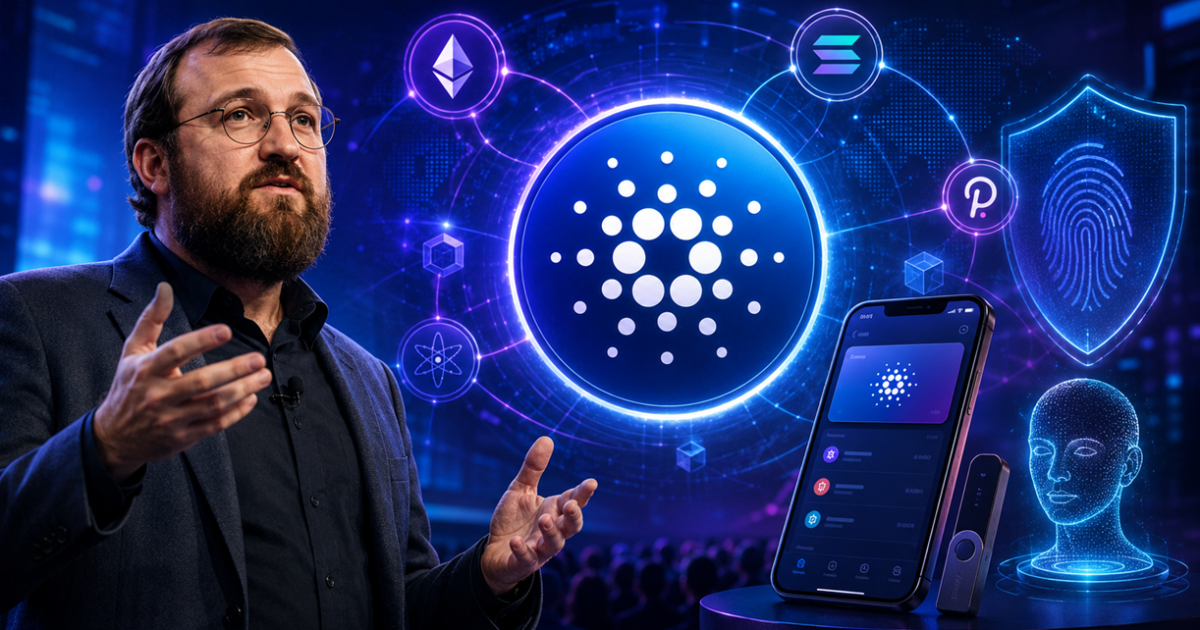
Charles Hoskinson argued at Consensus 2026 in Miami that crypto’s next phase requires simplifying self-custody, identity, and multi-chain access without sacrificing decentralization. The Cardano founder positioned Midnight Passport as a framework that solves what he called the industry’s core adoption problem: users fear losing control of their assets. Speaking Wednesday, Hoskinson contrasted crypto’s complexity—seed phrases, exchange navigation, network selection, fake app avoidance—with Web2 products like Google Wallet, which serves 1.5 billion users seamlessly. The gap between these user experiences represents the defining challenge for mainstream adoption in 2026.
Self-Custody Remains Crypto’s Adoption Bottleneck
Hoskinson framed the problem bluntly: “The number one problem that people say again and again and again when they think about cryptocurrencies is, I’m gonna fuck it up. The safety side. That is the user experience in 2026.” Current solutions force users to choose between complexity and risk. Managing seed phrases manually creates catastrophic failure modes. Delegating custody to exchanges or custodians eliminates that friction but reintroduces the centralization crypto was designed to escape. Near Protocol, for example, processed billions in transaction value through intents but charged users $71 million in fees over one year—a cost structure that reflects both innovation and ongoing inefficiency in abstracting away technical barriers.
Account Abstraction Trades Privacy for Convenience
Ethereum and Near Protocol have advanced account abstraction and chain abstraction to improve user experience, allowing transactions without direct seed phrase exposure. The trade-off is visibility. As Hoskinson noted, “When you abstract things, you delegate to people…they know you. They know what you’re buying. They know where you’re at.” Midnight Passport addresses this by combining mobile-native key management with self-sovereign identity and selective disclosure. The framework enables users to sign transactions across Bitcoin, Ethereum, Solana, and XRP without exposing personal data to intermediaries. Cardano, trading at $0.2689 at press time, remains the foundation for Input Output Global’s work on this infrastructure layer.
Multi-Chain Access Without Intermediaries
Hoskinson’s core assertion was direct: “I don’t care what networks you want to use. I don’t care what assets you want to have. I want you to have control of those assets.” Midnight Passport extends beyond Cardano to enable genuine cross-chain interoperability while maintaining privacy. This positions crypto infrastructure differently than current solutions, where users must choose between network lock-in and exposure to third-party visibility. As AI agents emerge as a significant force in crypto markets, Hoskinson argued that privacy protections become critical—personal context and transaction patterns require protection from both intermediaries and algorithmic surveillance.
The Unresolved Timeline
Hoskinson’s keynote clarified the problem and outlined a solution framework, but critical details remain unanswered: no launch date for Midnight Passport has been announced, technical specifications are incomplete, and specific privacy mechanisms await formal documentation. The framework’s real test will come in execution. Whether Midnight Passport can deliver the simplicity of Google Wallet with crypto’s decentralization guarantees will determine whether 2026 marks genuine progress toward mainstream adoption or another unfulfilled infrastructure promise.