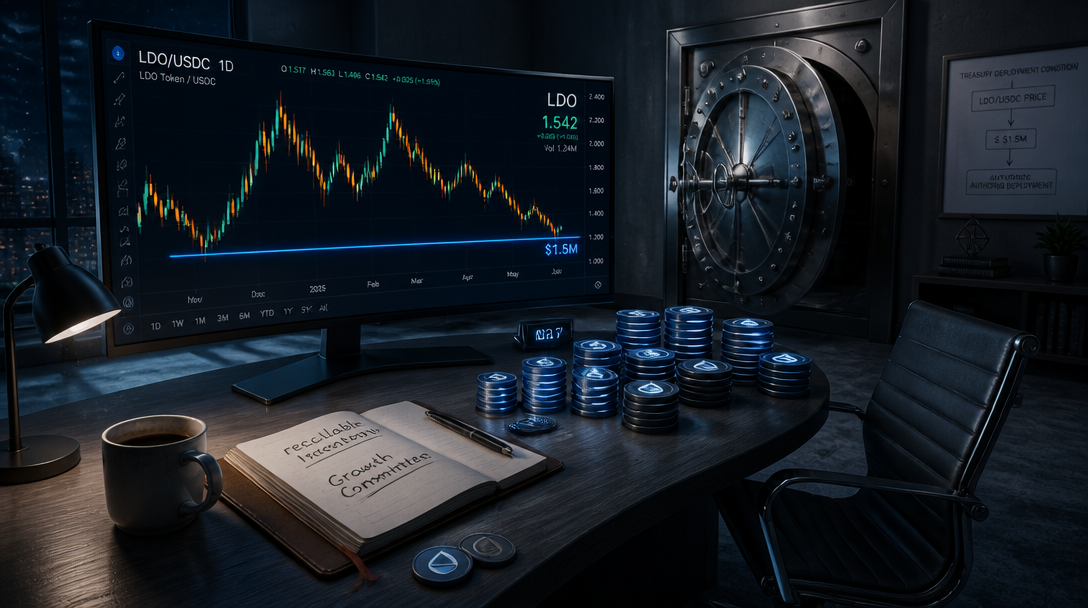
Lido DAO is considering authorizing a contingent market-making mandate that would allow up to 7.5 million LDO tokens and $480,000 USDC to be deployed as recallable inventory on centralized exchanges if liquidity deteriorates.
The proposal would keep assets in the DAO treasury until Lido’s Growth Committee determines that trading conditions on major exchanges have become or are likely to become insufficient. Rather than permanently transferring tokens to market makers, the mandate would make LDO available as recallable inventory, meaning the DAO retains control and can withdraw the tokens if needed.
The $1.5 million LDO authorization and $480,000 USDC allocation would cover retainer fees and related costs. The proposal explicitly favors fixed-retainer compensation structures over option-based arrangements, signaling a preference for simpler, more predictable market-making economics.
Liquidity Concerns Drive Proposal
LDO trading volume has fallen materially over the past year, according to the proposal materials. Thinner order books on centralized exchanges risk reducing the token’s attractiveness to those platforms. Once a token loses major exchange pairs, liquidity can fragment and fiat access becomes harder, the proposal notes.
The contingent structure allows the DAO to maintain a dormant backstop without deploying capital immediately. If liquidity conditions improve or remain stable, the mandate stays inactive and treasury resources remain available for other uses.
Internal Debate Over Treasury Allocation
DAO participants have questioned whether paying professional market makers represents the best use of treasury resources. Some have argued that the token should instead gain more organic utility rather than relying on paid liquidity support.
The proposal does not specify which centralized exchanges are targeted for the market-making arrangement. The DAO’s Growth Committee would hold discretion over when and how to activate the mandate if conditions warrant intervention.


