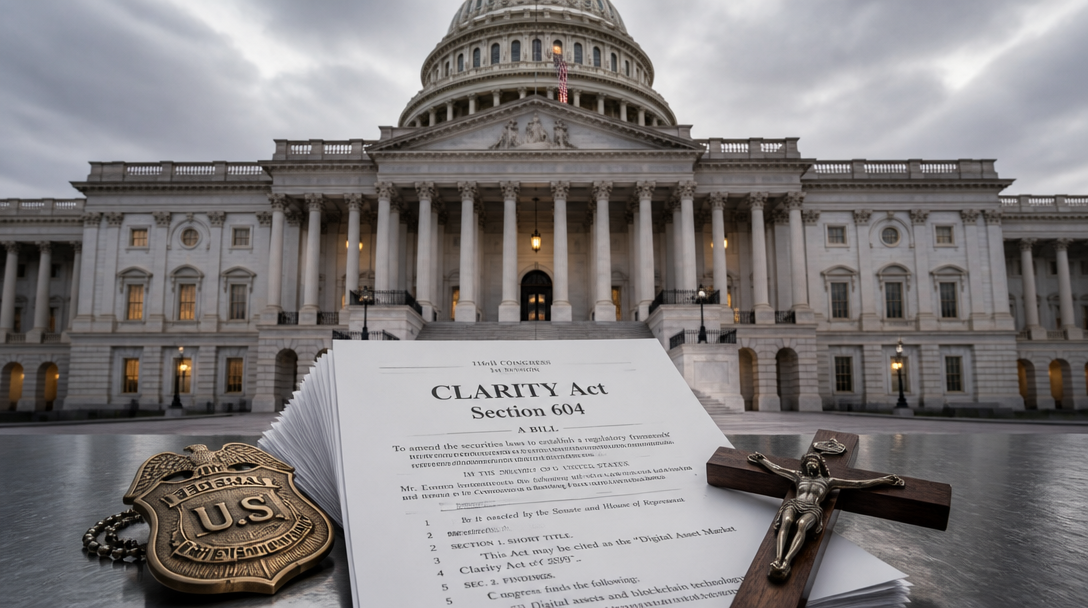
Four major law enforcement organizations representing 70,000 professionals warned Tuesday that Section 604 of the Digital Asset Market Clarity Act would create dangerous gaps in oversight of financial crime, as nearly 80 Catholic leaders and organizations joined the opposition.
The National District Attorneys Association, National Association of Assistant United States Attorneys, International Association of Chiefs of Police, and National Sheriffs’ Association sent letters to U.S. government officials objecting to the provision, which would exempt certain crypto developers and infrastructure providers from money transmitter rules.
“As currently drafted, Section 604 risks creating gaps in oversight and accountability that could impede those efforts,” the law enforcement groups wrote. They argued the exemptions are too broad and could shield actors facilitating asset movement while obstructing investigators.
Section 604 incorporates the Blockchain Regulatory Certainty Act, establishing that developers or infrastructure providers who cannot move or control user digital assets are not money transmitters. Law enforcement contends this language leaves too much room for bad actors to operate without detection.
The Catholic groups emphasized the real-world harm. “Human traffickers are quick to exploit new technologies when oversight fails to keep pace,” they stated in their letter, underscoring that exemptions without comparable suspicious activity monitoring and reporting obligations create vulnerability.
Law enforcement clarified their position is “not with individuals who merely write or publish software code, nor with responsible technological innovation.” The groups are targeting what they see as loopholes that allow financial crime to flourish under the guise of developer protections.
The House passed H.R. 3633 in July 2025 by a vote of 294-134. The Senate Banking Committee cleared the bill in May 2026 by 15-9, and the legislation has become a Trump administration priority. Congress has scheduled a hearing on the CLARITY Act for July 17, 2026, in New York.
The bill divides oversight of digital assets between the SEC and CFTC, creating a framework for crypto exchanges, brokers, stablecoin issuers, and DeFi participants. Passage requires 60 votes in the Senate.
Senators Mark Warner of Virginia and Catherine Cortez Masto of Nevada have tied their support to law enforcement’s approval of Section 604, giving the opposition groups significant leverage in negotiations. Senate Majority Leader John Thune and Senate Democratic Leader Charles Schumer will face pressure from both sides as the bill moves toward a floor vote.
Proponents of Section 604 argue the language protects software developers from criminal prosecution. Law enforcement groups counter that the current exemptions sweep too broadly, creating the very oversight gaps that enable financial crime.