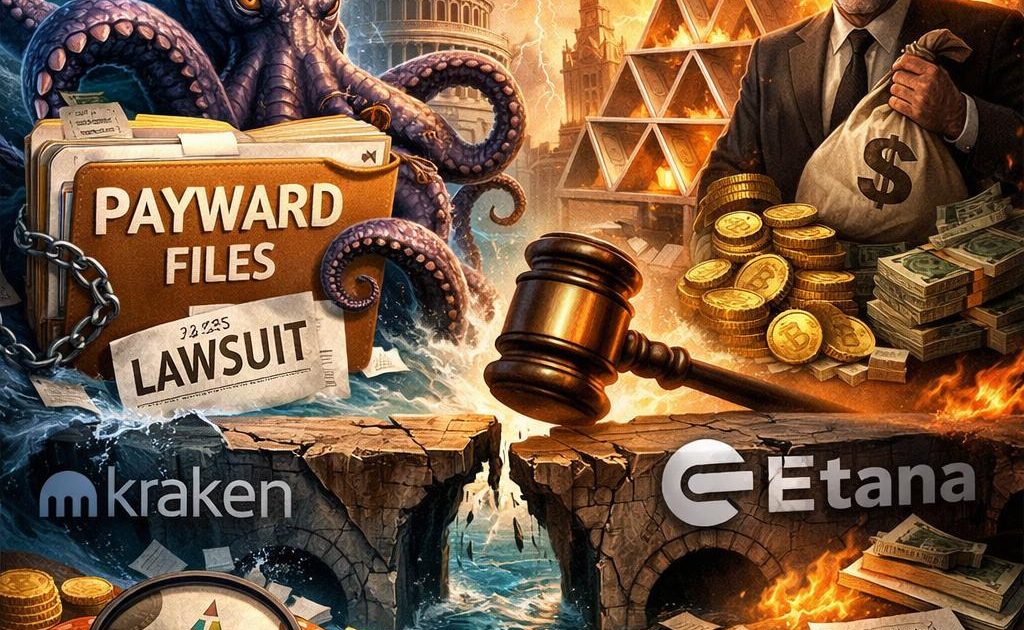
Payward, the parent company of cryptocurrency exchange Kraken, filed a lawsuit against custodian Etana Custody and CEO Brandon Russell, alleging the firm misappropriated $25 million in client funds and operated a structure resembling a Ponzi scheme. The lawsuit claims Etana commingled customer reserves with operational funds, issued false account statements, and covered shortages using new customer deposits. The allegations surfaced after Kraken attempted a $25 million withdrawal in April 2025 and Etana allegedly proved unable to meet the request.
How the Alleged Scheme Operated
According to the complaint, Etana Custody maintained false account statements showing customer funds as secured while shortages existed. The custodian allegedly used client reserves for operating expenses and foreign-exchange hedging while keeping profits for itself. Etana’s own legal team reportedly recommended disclosure to Kraken, but no such disclosure occurred. The structure depended on continuous deposits from new customers to cover previous shortages, creating what Payward characterizes as a Ponzi-like dynamic. Kraken had partnered with Etana since July 2018 for fiat on-ramp and off-ramp services.
Kraken’s Scale and Enforcement Response
Matt Turetzky, Kraken’s litigation head, described the situation as “wild” and stated the company would “find you” and “sue you” until “justice has been served.” Kraken processes hundreds of billions of dollars in quarterly transaction volume across millions of users. The exchange’s aggressive pursuit reflects the severity of the alleged breach. No statement has been issued by Etana Custody or Russell. The lawsuit marks an escalation in Kraken’s enforcement posture against service providers handling customer assets.
Regulatory Expansion Through Bitnomial Acquisition
On the same day as the Etana lawsuit announcement, Payward completed its acquisition of Bitnomial, a CFTC-regulated derivatives platform. The deal grants Payward access to Futures Commission Merchant (FCM), Designated Contract Market (DCM), and Derivatives Clearing Organization (DCO) licenses. These licenses enable CFTC-regulated spot margin, perpetuals, and options trading for US clients. Arjun Sethi, Kraken Co-CEO, stated that Bitnomial was “purpose-built for digital assets, not adapted to them,” positioning the platform as infrastructure “is what makes the next set of products possible.”
Custody Risk and Market Implications
The Etana allegations underscore ongoing custody risks in crypto infrastructure. With $2.6 trillion in total crypto market capitalization, proper asset segregation remains critical for institutional adoption. Payward’s dual moves—aggressive enforcement against alleged custodial misconduct and regulatory expansion through Bitnomial—signal a shift toward vertical integration and direct regulatory control. The lawsuit outcome will test liability frameworks for exchanges using third-party custodians and may influence how platforms vet and monitor service providers.