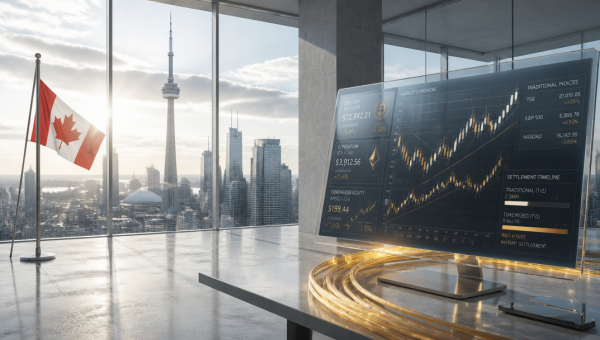
Institutional traders, prop firms, and automated agents are now competing alongside retail speculators in prediction markets, bringing professional capital and algorithmic pricing to event contracts on Kalshi and Polymarket.
The shift marks a structural change in how markets price uncertainty. Market makers, quantitative firms, funded-trading shops, and AI agents now provide counterparty liquidity in prediction markets. Institutional access layers including Clear Street, Marex, and Jump Trading have wired connections to both platforms, enabling banks and hedge funds to route capital directly into event contracts.
The scale is accelerating. Kalshi and Polymarket combined for $13.7 billion in monthly volume in June, with $11 billion already registered in July. Kalshi alone has annualized volume of $178 billion after tripling over six months. Institutional volume on Kalshi has climbed 800% as funded-trading shops and corporate treasuries test contracts to hedge tariff and regulatory exposure.
Fed rate expectations illustrate the institutional entry. Reuters polled 104 economists on July 21, and every one expected the Federal Reserve to hold rates at 3.50% to 3.75% when it meets July 28-29. Kalshi’s July contract reflects that consensus, pricing an 87% probability on that outcome across $29.7 million in volume, with 13% assigned to other outcomes.
Funded-trading firms are using resolved contracts to identify traders who can price uncertainty better than the crowd. Propr, an on-chain prop firm founded by Louis Régis, a former quantitative trader at Credit Suisse, treats every trade as a signal. “We’re confident about the direction, not the magnitude,” Régis said. Propr copies some signals onto live venues as A-booked positions and simulates the rest internally as B-booked ones. Payouts settle on-chain in USDC regardless of booking method. Propr offers traders an 80% profit share after passing evaluation, with maximum account sizes of $100,000 and maximum holdings of $300,000 across multiple accounts.
AI agents are testing prediction markets as a benchmark for autonomous trading. The Prediction Arena study gave six frontier AI models $10,000 each to trade autonomously on Kalshi and Polymarket between January 12 and March 9. Results were negative: AI models lost between 16% and 30.8% of capital on Kalshi and averaged a 1.1% negative return on Polymarket. Foresight Arena, a benchmark provider, estimates that detecting a real edge of two percentage points requires roughly 350 resolved binary predictions, or about 1,400 resolved predictions to confirm a one-point edge.
Price discovery varies by venue. A January 2026 working paper found Polymarket often led Kalshi in price discovery when liquidity and trading activity ran higher. Large directional order flow helped decide which venue moved first.
Corporate treasuries and specialist traders at Susquehanna, OKX, and AQR are among those testing event contracts. The next major data points arrive in early August: the Bureau of Economic Analysis publishes its advance GDP estimate on July 30, and the July employment report arrives August 7.