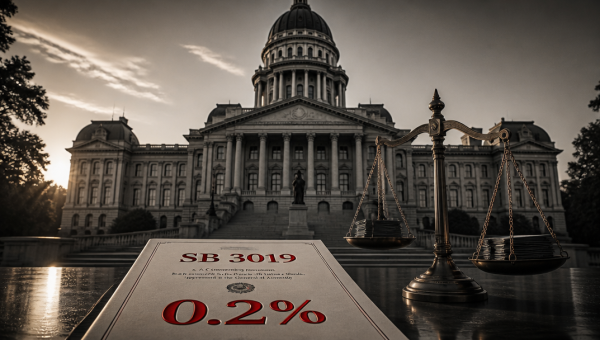
0.2% levy on digital asset brokers takes effect January 2027, drawing industry backlash over federal law violations
Illinois Governor J.B. Pritzker has signed a $55.9 billion state budget that includes a 0.2% privilege tax on cryptocurrency exchange, transfer, and custody activities, making Illinois the only state to levy a transaction-based tax specifically engineered for digital assets.
The tax, embedded in Senate Bill 3019 and called the Digital Asset Tax Act, takes effect January 2027. It applies to brokers generating $100,000 or more in annual Illinois receipts. The state estimates the tax will generate $60 million in annual revenue.
Brokers must register with the Illinois Department of Revenue and add the 0.2% charge as a separate line item on customer bills. The tax applies to holding and transferring assets, not just buy-and-sell trades. Sourcing rules deem a transaction as occurring in Illinois if the customer is physically present or if auxiliary data such as mailing address, account information, or IP address indicates Illinois as the primary place of use.
Non-compliance carries Class 3 felony charges, which carry prison sentences of two to five years and maximum financial fines of $25,000.
Industry leaders argue the tax violates federal law by singling out crypto. Miles Jennings, General Counsel at Andreessen Horowitz, stated: “There is effectively no comparable state financial transaction tax on stocks, bonds, or derivatives anywhere in the country. That means crypto is being singled out in violation of several federal laws.”
Traditional Wall Street assets face no equivalent state financial transaction tax. The tax was introduced in the final hours of the legislative session before sine die.
Justin Slaughter, Vice President of Regulatory Affairs at Paradigm, said: “The legislature has no idea what impact this will have on crypto trading in Illinois.”
Ji Kim, CEO of the Crypto Council for Innovation, warned: “States competing for the builder and digital asset community should take note of what not to do.”
Julian Berridi, Product Manager at Ripple, added: “Other states are courting crypto businesses. Illinois just gave them a reason to leave. Nobody else taxes brokers this way or backs it with felony charges. The jobs and the capital will go where they’re wanted, and that isn’t here.”
Illinois recently adopted the Digital Assets and Consumer Protection Act, which the industry had cautiously welcomed. Congress is currently working to establish a unified national tax framework for digital assets.
Industry Concerns Over State-Level Patchwork
The tax applies to all three core broker functions: exchange (buying and selling), transfer (moving assets between wallets), and custody (holding assets on behalf of customers). Industry advocates have warned that premature state-level laws could create a fifty-state patchwork conflicting with federal efforts to establish coherent national standards.