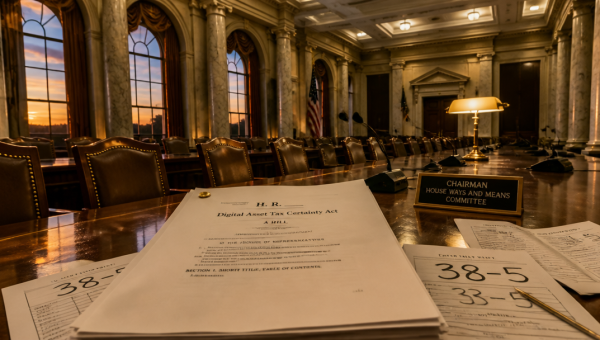
The House Ways and Means Committee is scheduled to consider H.R. 10357, the Digital Asset Tax Certainty Act, on September 16, putting a broad rewrite of digital-asset taxation before lawmakers after months of negotiations.
The bill pairs stablecoin tax relief with expanded trading rules, creating what crypto tax lawyer Andrew Gordon calls overdue clarity. “This is a massive step forward for crypto investors who simply want rules on tax. We all pay taxes, the rules need to be clear,” Gordon said.
The legislation is projected to increase federal receipts by $500 million from fiscal 2027 through 2036, according to Joint Committee on Taxation estimates. That net figure reflects competing revenue impacts: wash-sale restrictions and mark-to-market accounting expansions are expected to generate $4 billion combined, while stablecoin relief is estimated to reduce receipts by $2.365 billion over the same period.
Stablecoin Relief and Transaction Thresholds
Qualifying US dollar stablecoins would receive special treatment under the bill to prevent minor price movements around their $1 peg from creating taxable gains or losses. The legislation also disregards gains or losses when digital assets are used to pay network or transaction fees of no more than $10.
However, traders, brokers, dealers, and users completing more than 5,000 counted transactions are excluded from stablecoin relief. This threshold effectively limits the provision to retail investors and smaller-scale users.
Wash-Sale and Mark-to-Market Provisions
The bill extends wash-sale restrictions to traded digital assets other than qualifying US dollar stablecoins, closing a tax advantage crypto investors have held over stock traders. The wash-sale restrictions are estimated to increase federal receipts by $1.707 billion through 2036.
The legislation also expands access to mark-to-market accounting for digital-asset dealers and traders whose activities qualify as a trade or business. This provision is projected to generate $2.332 billion in additional federal receipts through 2036.
Staking, Lending, and Disclosure Framework
Staking rewards for individual miners and stakers are classified as ordinary income under the bill, maintaining the existing timing framework rather than deferring taxation until assets are sold. The bill extends tax treatment available for securities lending to qualifying digital-asset loans and prevents investment trusts from losing tax status solely because their trustee stakes digital assets.
Treasury would be directed to establish a Digital Asset Voluntary Disclosure Program allowing eligible taxpayers to correct past filings and receive potential penalty relief. The small-fee relief provision takes effect on December 31, 2027.