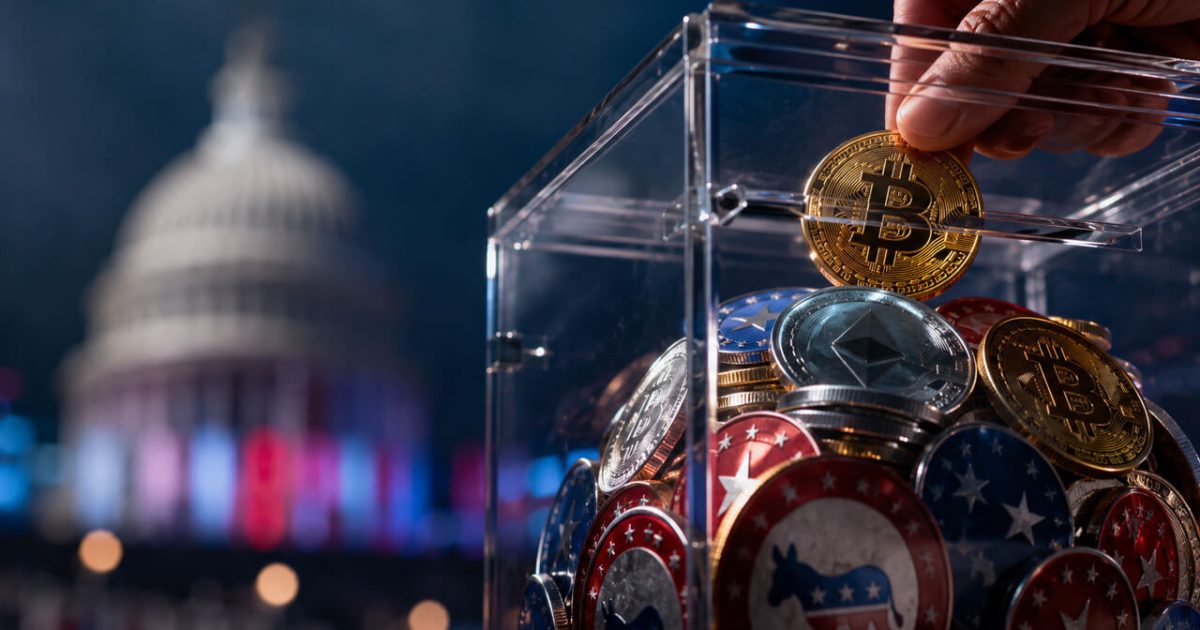
From regulatory target to political kingmaker in four years
Less than four years after the collapse of FTX triggered calls for a sweeping crackdown, the crypto industry has emerged as one of the fastest-growing forces in American politics. The sector deployed $139 million across the 2024 election cycle through super PACs, won 85% of backed races, and subsequently secured SEC case dismissals and new federal stablecoin legislation.
Fairshake, the industry-backed super PAC, and its two partisan affiliates, Defend American Jobs and Protect Progress, targeted 58 House and Senate races. The strategy proved effective: one in ten incoming Congress members received meaningful crypto industry ad support. Fairshake’s cross-party approach, operating simultaneously through Democratic and Republican channels, allowed the industry to influence electoral outcomes without committing to a single faction.
The regulatory payoff came swiftly. In early 2025, the SEC dismissed its civil action against Coinbase. Shortly after, the agency dropped its lawsuit against Binance. By November 2025, the SEC removed crypto from its 2026 examination priorities under new chair Paul Atkins, formally disowning the enforcement-first position that had defined Gary Gensler’s tenure.
In July 2025, Congress signed the GENIUS Act into law, delivering the first federal stablecoin framework the industry had lobbied for across multiple congressional sessions. The timing underscored the industry’s newfound legislative power.
Representatives Maxine Waters and Brad Sherman documented 12 cryptocurrency cases the SEC dismissed or closed since early 2024. They described the relationship between case closures and industry political spending as a “troubling correlation.”
The 2023 enforcement surge under Gensler had included 46 crypto-related actions. The SEC pursued landmark cases against Coinbase, Binance, and Ripple, treating most digital assets as unregistered securities. Ripple ultimately settled for $50 million with $75 million returned from escrow. Former SEC enforcement attorneys noted the scale of subsequent dismissals was unusual given the reportedly strong evidence assembled in several actions.
The industry’s political machine accelerated into 2026. Crypto-backed PACs deployed $220 million as a war chest for the midterms. In Texas alone, spending exceeded $2.5 million on congressional candidates year-to-date, up from $1 million across the entire 2024 cycle.
In May 2026, Protect Progress spent $5 million supporting Christian Menefee, a Democratic challenger in Texas’s 18th Congressional District, and $2.8 million opposing incumbent Representative Al Green, who voted against both the GENIUS Act and the Clarity Act. The total crypto-backed PAC deployment in the district reached $8 million.
Fellowship PAC, backed by Tether and led by Bo Hines, a former White House crypto adviser, reported $1.75 million spending backing Ken Paxton in a Texas Senate runoff. Paxton won the race, which the Texas Tribune described as a watershed moment ending over three decades of John Cornyn’s electoral dominance.
The industry’s transformation from regulatory target to political kingmaker reflects a deliberate strategy. Andreessen Horowitz built an aggressive lobbying operation designed to exclude crypto from SEC jurisdiction, serving as a template for the broader industry. Fairshake’s bipartisan approach allowed the sector to hedge its bets across both parties while maintaining consistent pressure on regulatory outcomes.
The 2024 cycle demonstrated the model’s viability. The 2026 midterms will test whether the industry can sustain its influence as it faces renewed scrutiny from lawmakers skeptical of its rapid political ascent.