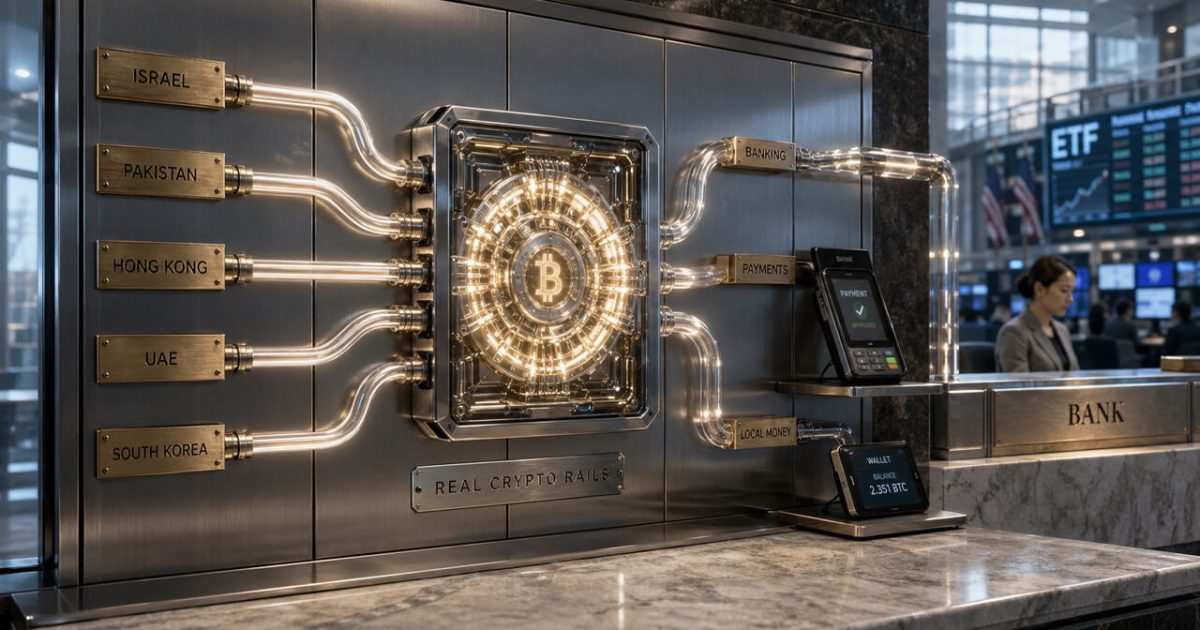
Israel approved a shekel-pegged stablecoin and Pakistan lifted its eight-year crypto banking ban this spring, marking a decisive pivot away from US-driven asset legitimacy toward operational integration with local financial systems. The moves signal that mainstream crypto adoption now depends less on ETF accessibility and more on connecting digital assets directly to bank accounts, settlement rails, and merchant checkouts. With crypto market capitalization near $2.59 trillion as of late April 2026, regulators across jurisdictions are treating stablecoins and digital assets as financial infrastructure rather than speculative instruments.
From Asset Class to Payment Rails
Israel’s approval of BILS, a shekel-pegged stablecoin issued by local firm Bits of Gold, represents a 2-year pilot designed to test programmable local currency on-chain. This differs fundamentally from Bitcoin or Ethereum exposure via US spot ETFs, which provide investment vehicles but no direct utility in daily settlement or payments. Pakistan’s State Bank circular, issued in April 2026, reversed a 2018 virtual-currency prohibition that had locked crypto firms out of traditional banking entirely. Licensed virtual asset service providers can now open bank accounts, enabling the transition from informal peer-to-peer networks to traceable institutional channels. The distinction matters: integration with banking infrastructure creates regulatory visibility and operational stability absent in offshore-only models.
Global Regulatory Convergence on Digital Infrastructure
Hong Kong granted stablecoin licenses to Anchorpoint Financial Limited and HSBC on April 10, 2026, establishing conduct frameworks for tokenized fiat issuance. Japan’s Financial Services Agency is shifting its regulatory approach to accommodate digital assets within existing financial rules. The UK Financial Conduct Authority opened applications for new crypto authorization on September 30, 2026, with the regime expected to come into force by October 25, 2027. The European Union’s MiCA framework, the UAE Central Bank’s payment-token register, and South Korea’s merchant integration pilots through Crypto.com and KG Inicis all point to the same pattern: regulators treating crypto as operational financial infrastructure, not speculative assets. This represents a 180-degree shift from 2023-2024 regulatory posture, which focused on custody, market manipulation, and investor protection.
Merchant Integration and Cross-Border Settlement Tests
Practical adoption is now moving beyond trading and custody into payment rails. South Korea’s K Bank and Ripple launched a cross-border payment pilot in April 2026, testing whether stablecoins and blockchain settlement can reduce friction in remittances and institutional transfers. Crypto.com and KG Inicis announced merchant payment integration in March 2026, embedding digital-asset checkout options into point-of-sale systems. These pilots address the core infrastructure gap: moving money from bank account to merchant terminal via blockchain requires coordination between payment processors, merchant networks, and licensed issuers. None of this was possible under pure prohibition regimes or when regulators treated crypto as a non-financial asset.
The Unresolved Question: Adoption at Scale
BILS issuance and actual usage data remain unavailable, as does confirmed adoption evidence for the UAE’s dirham-pegged token or transaction volumes from South Korea’s merchant pilots. Pakistan’s licensing timelines and which banks will onboard VASPs are still unclear. However, the policy alignment across Israel, Hong Kong, Japan, the UK, the EU, and the UAE indicates that regulators have moved from prohibition or prohibition-adjacent frameworks to operational integration frameworks. The next phase of crypto adoption will be measured not by ETF inflows but by transaction volume, merchant acceptance, and daily settlement activity in local currency stablecoins.