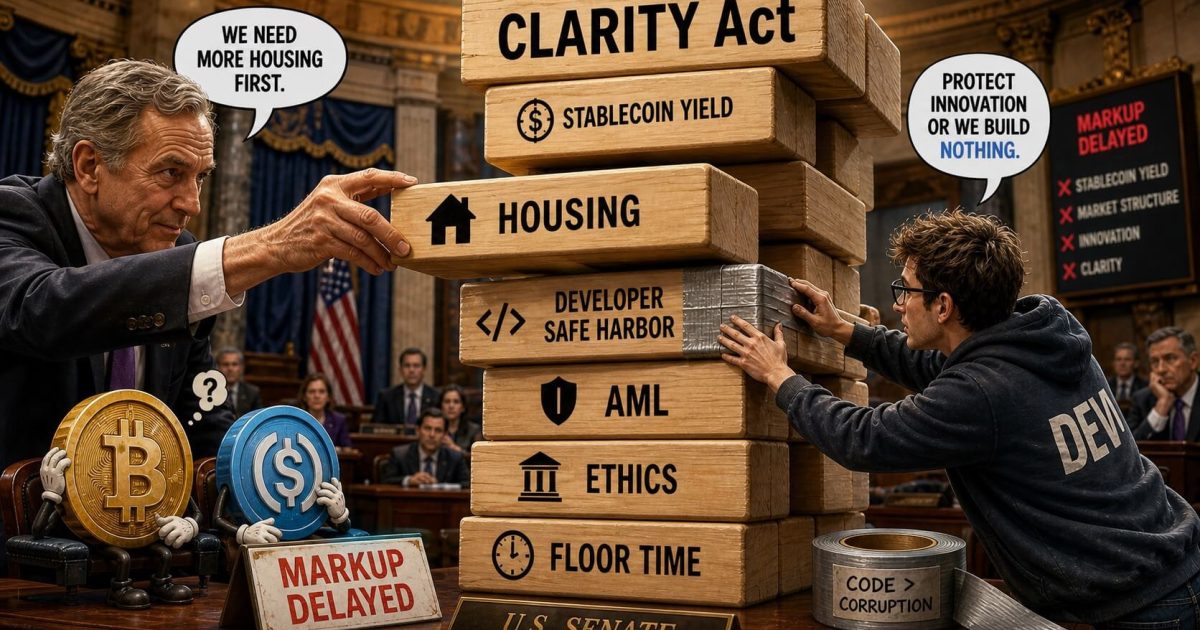
The Senate Banking Committee’s effort to advance the CLARITY Act faces an unexpected mid-May deadline crunch, not because of unresolved crypto policy, but because Sen. John Kennedy is using the bill’s momentum to extract concessions on unfinished housing legislation. The stablecoin yield compromise between Sens. Tillis and Alsobrooks has already resolved the primary policy deadlock, but the markup remains blocked pending Republican vote consolidation—13 of 13 GOP members must align—and Kennedy’s leverage over the housing file threatens to compress the legislative calendar into summer’s tightening window before election-year constraints take hold.
Yield Compromise Solves Policy; Politics Remains Unsettled
The Tillis-Alsobrooks framework resolved the stablecoin yield dispute by permitting activity-tied rewards while banning passive yield on idle balances. This compromise addressed banks’ core concern that broad language around “economically or functionally equivalent” arrangements could enable yield workarounds despite the stated restriction. However, the policy victory masks three distinct political obstacles: Kennedy’s unrelated housing demands, unresolved language on software developer protections under Section 1960 of the bill, and law enforcement’s objections to broad carve-outs for noncustodial developers citing AML and money transmitter enforcement risks. Galaxy Digital’s analysis identified these open items in April, flagging mid-May as the critical deadline for markup to preserve a viable legislative window before summer constraints.
Timeline Compression Threatens House Coordination Window
Missing the mid-May markup deadline compresses the remaining calendar significantly. The EU’s MiCA framework takes full effect July 1, 2026, creating international competitive pressure for US regulators and legislators. Hong Kong’s approval of the first stablecoin issuer licenses in April 2026 underscores the global regulatory race. On the domestic side, Bitcoin ETF flows signal sustained institutional appetite—BlackRock’s IBIT alone held $63.5 billion in net assets on May 1, 2026, with US Bitcoin ETFs collectively capturing $630 million in inflows over the same period. Galaxy estimates CLARITY Act passage odds at 50-50, while Polymarket data showed approval odds surging from 47% to 64% over the prior week. These metrics suggest market confidence, but legislative delay erodes that window.
Developer Protections and Law Enforcement Standoff
The software developer protection language remains the least resolved technical element. Section 1960 carve-outs for noncustodial developers face law enforcement opposition over scope and AML compliance gaps. Unlike the stablecoin yield issue, which had a clear policy compromise, the developer protection debate pits crypto industry interests against federal enforcement priorities with no agreed framework yet public. This dispute is capable of reopening opposition even after the yield compromise is finalized, particularly if Senate Democrats or House members align with enforcement concerns during floor or conference stages.
Kennedy’s Housing Leverage and the Closing Window
Kennedy’s frustration over unfinished bicameral work on housing legislation—specifically the 21st Century ROAD to Housing Act and Build Now Act—has given him explicit leverage over the crypto vote timeline. No official statement from Kennedy has directly linked housing demands to the CLARITY Act delay, but the structural reality is clear: the markup cannot proceed without 13 Republican votes, and Kennedy controls one of those thirteen. With summer constraints and election-year dynamics narrowing the legislative calendar, the window for final passage before 2026 recess closes rapidly. Tim Scott’s Banking Committee leadership depends on unanimous Republican support, making any holdout capable of derailing the entire schedule.