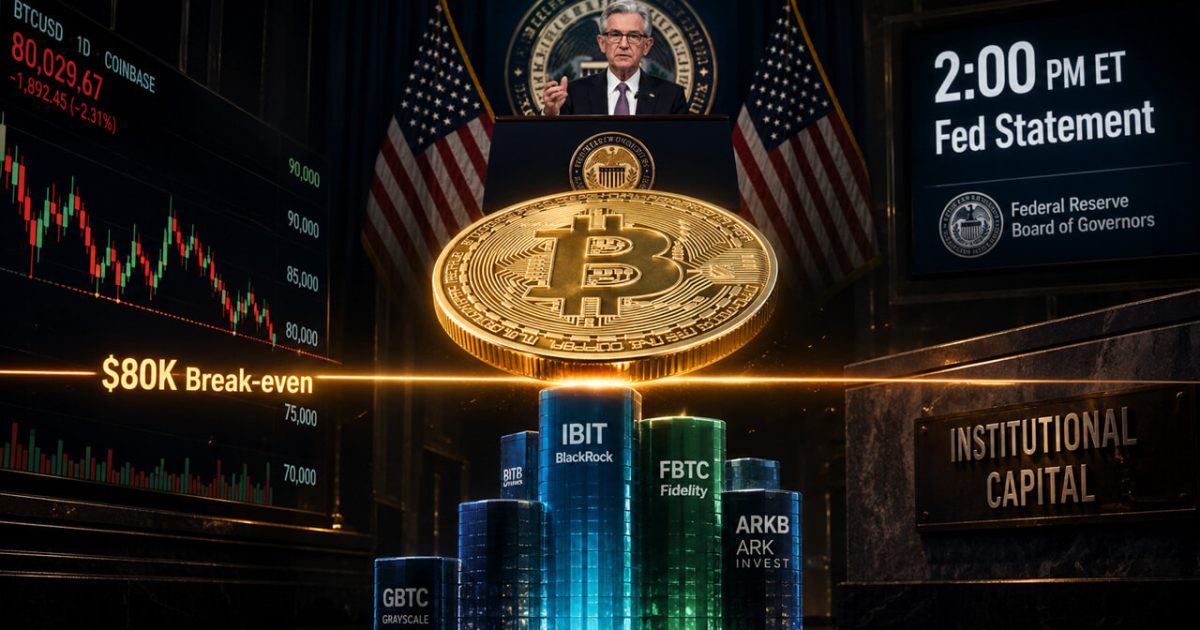
Bitcoin approached $77,800 on Wednesday ahead of the Federal Reserve’s April 28-29 meeting, facing a critical test at the $80,000 level where long-term holders near break-even may decide to exit. Nine consecutive days of US spot Bitcoin ETF inflows totaling $2.12 billion since April 14 have fueled the rally, but institutional demand faces a decisive moment when Jerome Powell holds his press conference at 2:30 p.m. ET on April 29. The outcome hinges not on whether the Fed holds rates, which markets price at 100% probability, but on Powell’s language around inflation divergence and forward guidance that could shape Bitcoin’s macro narrative for the next six weeks.
Institutional Accumulation Meets Break-Even Pressure
Bitwise analysis identified concentrated cost-basis clusters at $80,000 (short-term holder cost basis) and $79,000 (True Market Mean), creating a break-even zone where conviction becomes measurable. Over the past 30 days, ETPs and corporate treasuries have accumulated 92,900 BTC, signaling structural demand beyond short-covering rallies. US spot Bitcoin ETFs now hold $101 billion in net assets, representing 6.57% of Bitcoin’s total market cap. Yet this accumulation faces an immediate test: holders who entered near previous peaks must choose between accepting break-even exits or holding for conviction that institutional demand can absorb selling pressure at the $80,000 behavioral threshold.
Fed Decision Sets Macro Narrative for May
The Federal Reserve’s decision to hold the fed funds rate at 3.50%-3.75% is certain, but the real event is Powell’s assessment of inflation divergence. Headline inflation sits at 3.3% while core inflation stands at 2.6%, creating ambiguity around whether the Fed perceives sticky inflation or transitory energy shocks from the Iran conflict and Strait of Hormuz closure. This uncertainty matters for Bitcoin because a dovish pivot could extend the rally past $80,000, while hawkish language citing headline inflation risks could trigger profit-taking at break-even. Kevin Warsh assumes the Fed Chair role on May 15, and his perceived hawkish stance on balance-sheet normalization adds post-decision policy uncertainty to the market’s calculus.
Earnings Catalysts and Data Releases Compound Volatility
Immediately after the Fed statement, Microsoft, Alphabet, Meta, and Amazon report Q1 2026 earnings after market close on April 29. Thursday morning brings Q1 GDP, PCE inflation, and Employment Cost Index data, creating a volatile 36-hour window where Bitcoin must navigate Fed policy, tech earnings surprises, and fresh macro data. The $80,000 level will likely see tested selling if any catalyst signals economic weakness or Fed hawkishness. Conviction requires institutional buyers to absorb that pressure without flinching, a test that historically determines whether rallies hold their structure or revert to lower cost bases.