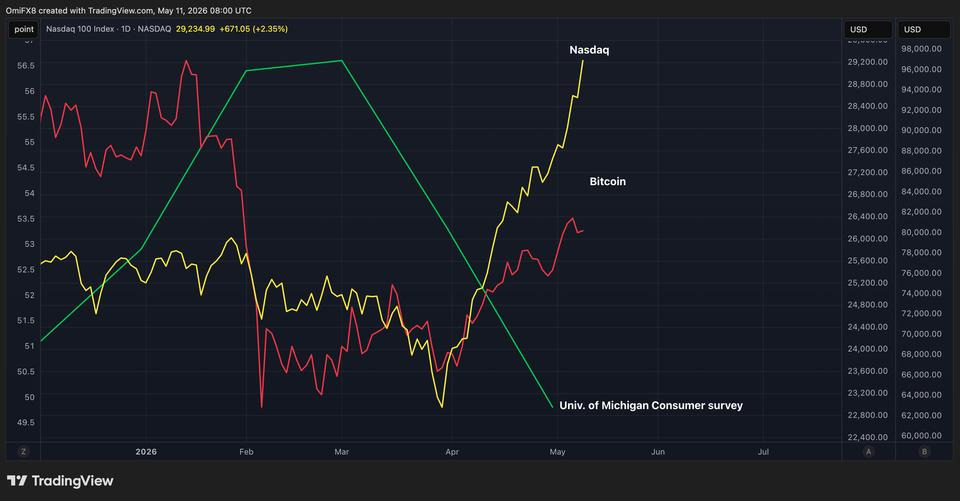
Bitcoin and the Nasdaq have surged sharply in 2026 while U.S. consumer sentiment has fallen to record lows, exposing a widening chasm between institutional market gains and household financial anxiety. Bitcoin climbed 11.8% in April alone and now trades at $80,700, while the Nasdaq has gained 22% since April 1, reaching 23,235 points. Yet the University of Michigan’s consumer sentiment index dropped to 48.2 points on Friday, the lowest reading on record, declining 7.7% year-over-year. The disconnect reveals how institutional capital and retail America are now operating in separate economic realities.
Institutional Capital Drives Tech and Crypto Higher
The rally across equities and digital assets reflects sustained institutional inflows into artificial intelligence, semiconductors, and Bitcoin itself. The S&P 500 has climbed 12% to 7,398 points as mega-cap tech earnings remain strong. Spot Bitcoin ETFs, launched two years ago, have channeled billions in institutional capital into crypto, fundamentally reshaping how the asset behaves in macro markets. According to Alvin Kan, COO of Bitget Wallet, “Institutional capital continues flowing into AI, semiconductors, and digital assets, pushing the Nasdaq and Bitcoin higher as markets price in long-term productivity growth and technological transformation.” This institutional momentum has decoupled Bitcoin from retail sentiment entirely, tying it instead to equity market cycles and liquidity conditions.
Main Street Faces Inflation, Gas, and Tariff Pressures
Consumer anxiety stems from immediate financial pressures. One-third of survey respondents cited gas prices as a primary concern, while another third pointed to tariffs. The consumer sentiment index fell from 49.8 in April to 48.2 in the latest reading. Despite 62% of American adults owning stocks and 30% holding cryptocurrency, household confidence remains severely depressed. Kan noted the core paradox: “Markets are trading the future while consumers are still focused on present-day financial pressure.” High living costs, persistent inflation expectations, and economic uncertainty are keeping Main Street consumers from celebrating asset price gains.
Crypto’s Wealth Concentration Problem
The rally has exposed a deeper contradiction in crypto’s founding promise. Bitcoin was marketed as a democratizing force for finance, yet institutional adoption has concentrated gains among sophisticated investors and large holders. Markus Thielen, founder of 10x Research, stated bluntly: “The democratization of finance was once one of crypto’s defining promises, yet reality has moved in the opposite direction. Wealth remains heavily concentrated in the hands of a small minority.” The trend mirrors the broader stock market, where mega-cap tech gains have accrued almost entirely to wealthy participants while middle-income households struggle with daily expenses.
Divergence Expected to Persist Amid Uncertainty
Gracy Chen, CEO of Bitget, expects the gap between Wall Street and Main Street to widen further. “This gap is expected to persist,” she said, though regulatory shifts, geopolitical events, or monetary tightening could apply near-term pressure. Chen added that crypto’s emerging ecosystem is maturing as a tool for institutional diversification and risk management in volatile markets. The disconnect between soaring asset prices and collapsing consumer confidence signals a bifurcated economy where institutional players benefit from structural trends while average households remain trapped in an affordability crisis.