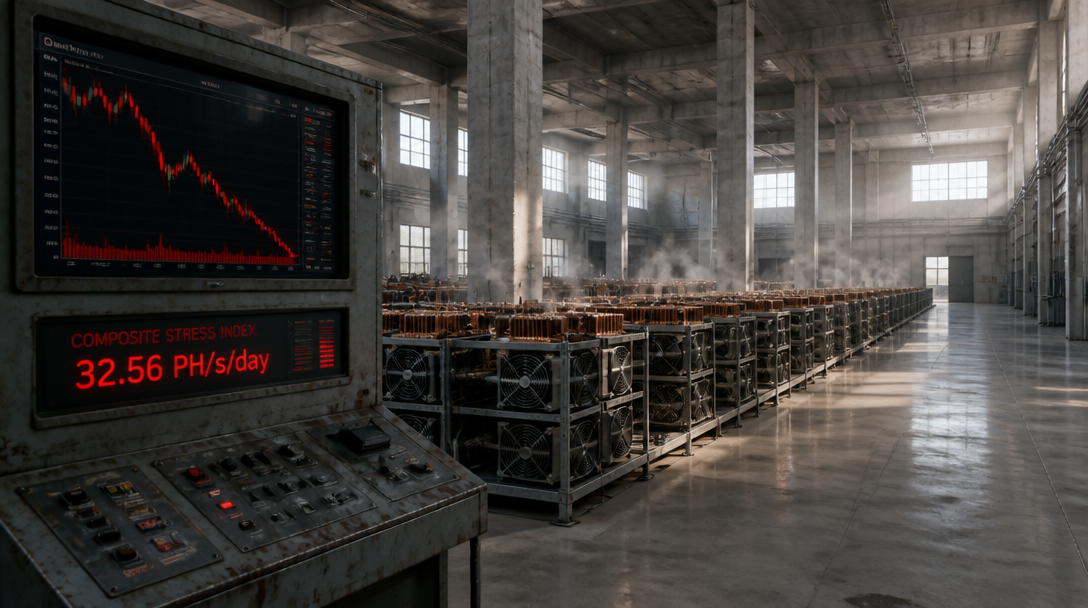
Composite Signal Falls Into Undervalued Territory, Reviving Miner-Pain-at-Bottom Thesis
The Miner Cycle Stress Composite for Bitcoin has fallen to new 2026 lows in undervalued territory, according to analyst Gaah, signaling severe operational pressure across mining fleets and reigniting the familiar market cycle claim that miner distress often precedes price bottoms.
The composite, which combines the Puell Multiple and an inverted Miner Capitulation Index, tracks miner revenue relative to newly issued bitcoin value alongside capitulation signals. Hashprice, the primary input, reflects block subsidy, transaction fees, network difficulty, and Bitcoin price. On June 1, the USD hashprice stood at $32.56 per PH/s/day, down 9.0% over the week, with the six-month forward average at $31.71. The metric rebounded modestly to $33.74 on June 15, though the six-month forward average remained compressed at $32.13.
The pressure is not uniform across mining hardware. Newer, efficient sub-19 J/TH fleets generate $81 in compute revenue per MWh, while older 25-38 J/TH equipment produces only $43 per MWh. According to Hashrate Index’s Q2 2026 report, older 25+ J/TH hardware was operating at negative gross margins at all-time-low hashprice levels, forcing operators into a binary choice: curtail, sell treasury reserves, consolidate, or pivot to AI and high-performance computing workloads.
Network hashrate declined 5.8% quarter-over-quarter, falling from 1,066 EH/s in Q1 2026 to 1,004 EH/s in Q2. Hashrate Index estimated 252 EH/s of marginal capacity offline. As of July 6, Bitcoin traded at $63,007, with a market capitalization of $1.26 trillion and 58.0% dominance.
Miner stress can trigger self-correction. When unprofitable machines shut down, network hashrate declines, difficulty resets lower, and revenue improves for remaining operators. This dynamic has historically marked inflection points in Bitcoin cycles, though the composite’s current reading does not guarantee immediate recovery. BGeometrics data from July 4 showed BIP-110 miner signaling at 0.42% since May 1, indicating minimal adoption of the proposed signal so far.
The stress index decline reflects the structural reality facing mining operators: hashprice compression leaves no margin for error. Efficient miners survive; inefficient ones face curtailment or exit. The undervalued composite reading signals that market structure has reached a point where further pressure may be unsustainable, but recovery timing and trajectory remain contingent on Bitcoin price action and network hashrate behavior.