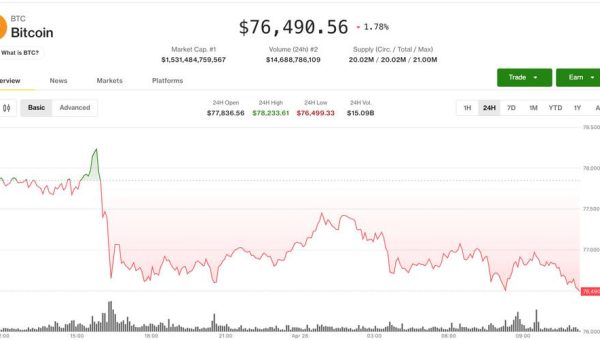
Bitcoin institutional inflows recovered sharply over three consecutive weeks ending April 27, with crypto funds capturing $1.1 billion, $1.4 billion, and $1.2 billion in successive weeks. Yet the momentum shows cracks. Spot Bitcoin ETF flows reversed to negative on April 27 alone, and resistance at $80,100 threatens to cap near-term gains as the Federal Reserve prepares for its April 28-29 policy decision.
Institutional Capital Returns After Market Weakness
The rebound in Bitcoin institutional inflows marks a sharp reversal from earlier weakness. CoinShares data tracking crypto fund flows reveals $933 million flowed into Bitcoin products in the most recent week, paired with $192 million into Ethereum. US regional demand alone accounted for $1.1 billion. Corporate treasury accumulation reinforced the trend. Strategy, the largest Bitcoin corporate holder, purchased 3,273 BTC during April 20-26, bringing its total holdings to 818,334 BTC valued at $61.8 billion at cost. Bitfire, a Hong Kong-listed asset manager, targets 10,000 BTC accumulation within a year. BlackRock’s IBIT spot ETF held $908 million in aggregate assets under management, signaling sustained institutional participation despite broader market uncertainty.
Derivatives Volume and Resistance Levels Define Market Structure
CME cryptocurrency derivatives recorded 313,900 open interest contracts in Q1 2025, a 25 percent increase year-over-year, while contract volume expanded from 191,000 to 310,000 contracts. The stablecoin market cap reached $320.7 billion, up 1.73 percent over 30 days, providing the on-ramp infrastructure for sustained institutional entry. However, Glassnode’s on-chain analysis reveals structural fragility. Bitcoin’s True Market Mean stands at $78,100, yet short-term holders face resistance at $80,100—the cost basis where 54 percent of recent buyers would achieve profitability. Realized profit rates have surged to $4.4 million per hour, double the historical threshold of $1.5 million per hour, indicating aggressive profit-taking at resistance levels.
Offshore Activity Masks Coinbase Weakness
The institutional inflow narrative obscures a critical divergence. Coinbase, the primary US institutional spot venue, shows muted activity, while Binance and offshore exchanges drive the majority of buying pressure. This suggests the recovery leans heavily on retail capital and offshore institutional demand rather than domestic institutional conviction. The $2 billion in spot ETF inflows across nine trading sessions provides headline support, but the April 27 reversal signals fragility. Total crypto fund assets under management stand at $155 billion, down 41 percent from the October 2025 peak of $263 billion, indicating the sector remains below prior institutional confidence levels.
FOMC Decision Will Test Institutional Resolve
The Federal Reserve’s April 28-29 policy decision represents the immediate catalyst for institutional positioning. A hawkish hold or rate hike could trigger profit-taking at $80,100 resistance. A dovish signal could accelerate inflows toward the October AUM peak. Until then, Bitcoin institutional demand remains conditional rather than structural, vulnerable to macro shifts and regulatory developments. Traders monitoring this recovery should watch spot ETF flows, CME open interest, and corporate treasury announcements as leading indicators of genuine institutional appetite beyond near-term tactical positioning.