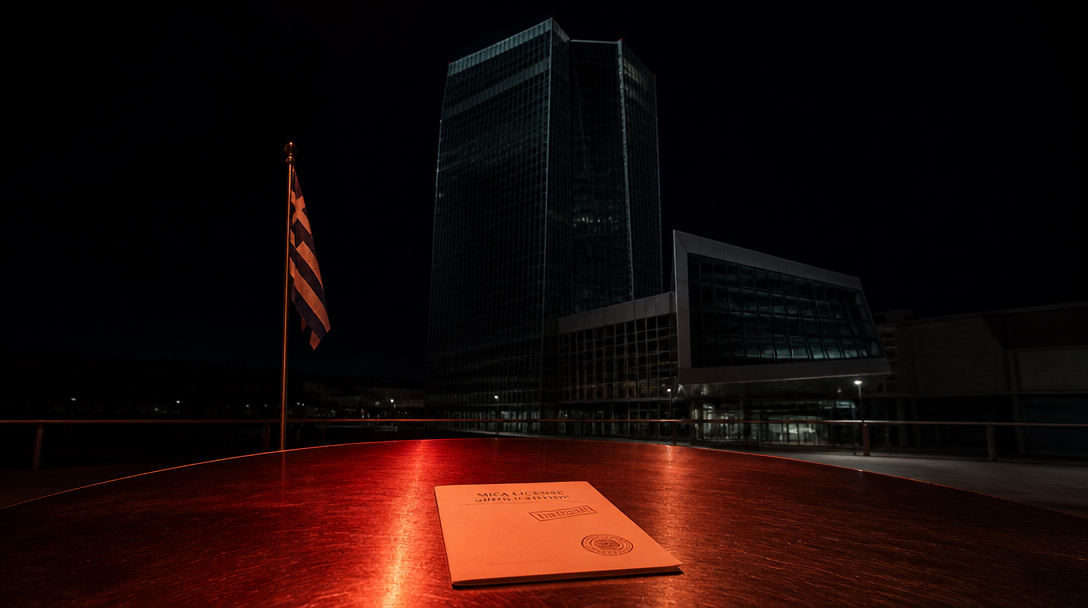
ECB President Lagarde’s informal role in licensing decision raises questions about regulatory boundaries under Europe’s crypto rulebook
Binance’s application for a Markets in Crypto-Assets Regulation (MiCA) license in Greece is facing potential rejection, with reports suggesting that European Central Bank President Christine Lagarde signaled to Greek Prime Minister Kyriakos Mitsotakis that the exchange was not welcome in Europe.
Reuters reported that Greece’s market regulator, the Hellenic Capital Market Commission (HCMC), was set to reject the application. The Big Whale subsequently reported that Lagarde had communicated Binance’s unwelcome status to Mitsotakis, raising questions about whether the ECB exercised informal influence over a licensing decision that formally rests with national competent authorities under MiCA.
The regulatory framework assigns approval of crypto-asset service provider (CASP) licenses to national authorities, not EU-level institutions. ECB involvement is explicitly defined in MiCA only for stablecoin issuers, not exchanges. Yet nothing in the MiCA framework prevents informal coordination.
“Nothing in the MiCA framework would prevent a third party like the ECB from offering its opinion to that national authority on Binance’s application,” said David Lesperance, founder of Lesperance & Associates. Yuriy Brisov, a lawyer at Digital & Analogue Partners, added that MiCA “contains nothing that stops the ECB from talking to, advising, or sharing concerns” with national regulators, though he noted that stablecoin oversight “parks in the stablecoin chapter, not in the exchange-license one.”
The ECB has consistently opposed privately issued stablecoins, with officials including Executive Board member Isabel Schnabel warning that such instruments could reinforce US dollar dominance. Lagarde has argued that Europe should prioritize regulated settlement systems anchored by central bank money rather than relying on private alternatives. Binance is the world’s largest stablecoin exchange and dominant hub for stablecoin liquidity, holding approximately $47.5 billion in USDT and USDC combined as of February. The exchange controls 65 percent of total stablecoin reserves across centralized platforms.
Binance disputed the rejection narrative in a blog post, stating that its understanding was that the HCMC “completed its review of the application and considered it compliant with MiCA requirements” and that the application was subject to review at the European Securities and Markets Authority (ESMA) level. However, ESMA does not itself authorize CASP licenses under MiCA, creating ambiguity around Binance’s characterization of the process.
The Big Whale reported that France could represent Binance’s remaining route to a European license, though no formal French application has been filed. MiCA’s transitional period ends July 1, determining which crypto firms can continue operating across the EU. The Binance application in Greece was submitted in January.
Brisov noted that the HCMC has not published a formal decision, leaving the application’s status unclear despite conflicting public statements about its fate.