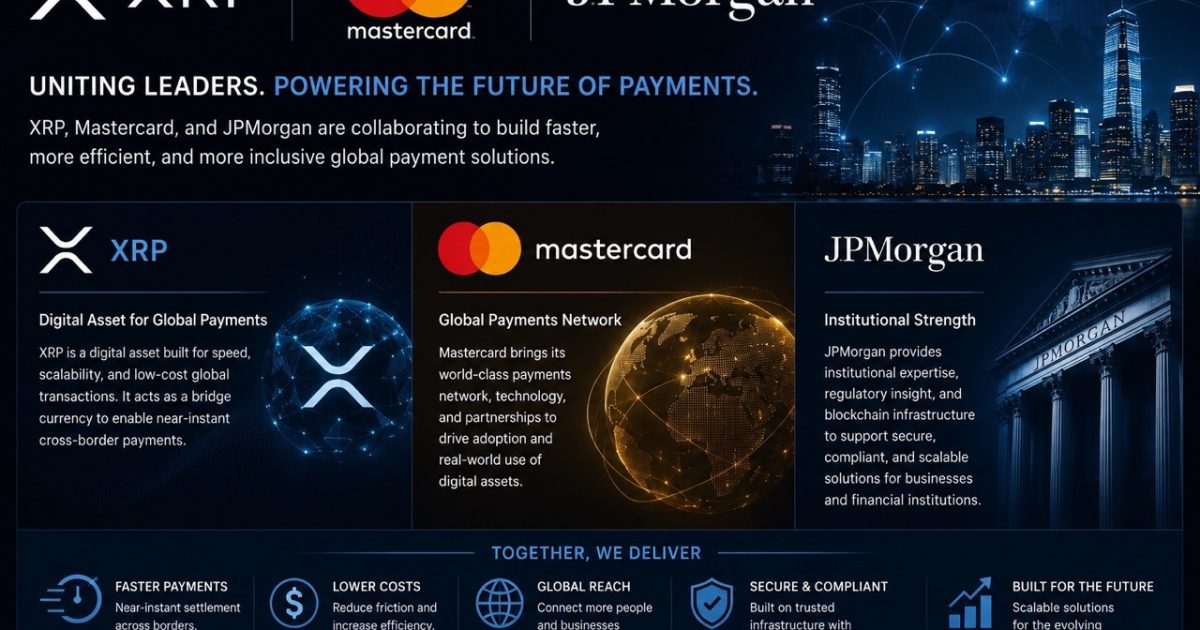
Ripple, Mastercard, and JPMorgan completed a blockchain-based settlement pilot using the XRP Ledger to process tokenized US Treasuries outside traditional banking hours, demonstrating near real-time cross-border settlement capability across interbank payment rails. The transaction, announced May 6, 2026, marks the first documented instance of a public blockchain network settling institutional-grade assets continuously without market closures. The pilot connected Ondo Finance’s OUSG tokenized treasury product ($670 million in assets under management) with Mastercard’s payment routing infrastructure and JPMorgan’s Kinexys fiat delivery platform, creating an end-to-end settlement pathway that bypasses traditional time zone and operational hour constraints.
XRP Ledger Bridges Traditional and Blockchain Settlement
The pilot architecture integrated XRP Ledger’s public blockchain settlement layer directly with existing interbank payment systems. Unlike traditional cross-border transfers that require correspondent banking chains and operate within banking hours, the transaction settled in near real-time on a network that runs 24/7. Mastercard confirmed the completion via social media, describing the pilot as “groundwork for financial markets capable of operating continuously without closing hours.” The integration required no intermediary settlement agents between blockchain confirmation and fiat delivery, a significant reduction in operational friction for institutional treasuries. Kinexys, which already processes billions of dollars in daily transaction volume, handled the fiat leg of the settlement without requiring additional infrastructure modifications.
Tokenized Treasuries Enter Institutional Settlement Phase
OUSG, Ondo Finance’s tokenized short-term US Treasury fund, now joins BlackRock and Franklin Templeton’s comparable offerings as an asset class capable of settling on continuous blockchain networks. The $670 million AUM product demonstrates institutional demand for tokenized government securities that can move 24/7. This pilot differs from previous blockchain settlement experiments because it connected a real asset (treasuries) with real payment volume (Kinexys’ billions daily) and real banking infrastructure (JPMorgan’s fiat rails). The transaction involved cross-border transfer between multiple banks, confirming that XRP Ledger settlement can coordinate across jurisdictions without traditional settlement windows. Market hours no longer constrain institutional treasuries moving through this pathway.
Continuous Settlement Redefines Interbank Rails
The pilot addresses a structural inefficiency in global finance: institutional assets freeze during banking closures despite market demand for 24/7 liquidity. Traditional interbank payment systems like SWIFT and FedWire operate within defined operational windows. Public blockchains like XRP Ledger operate without closure. By connecting both layers, Ripple has demonstrated that continuous settlement is technically feasible at scale. The next variable is regulatory clarity on 24/7 institutional asset transfers and whether central banks will modify settlement frameworks to accommodate continuous blockchain networks. If replicated across major asset classes, this model could reduce settlement risk and unlock trillions in weekend and after-hours liquidity currently locked in traditional banking infrastructure.