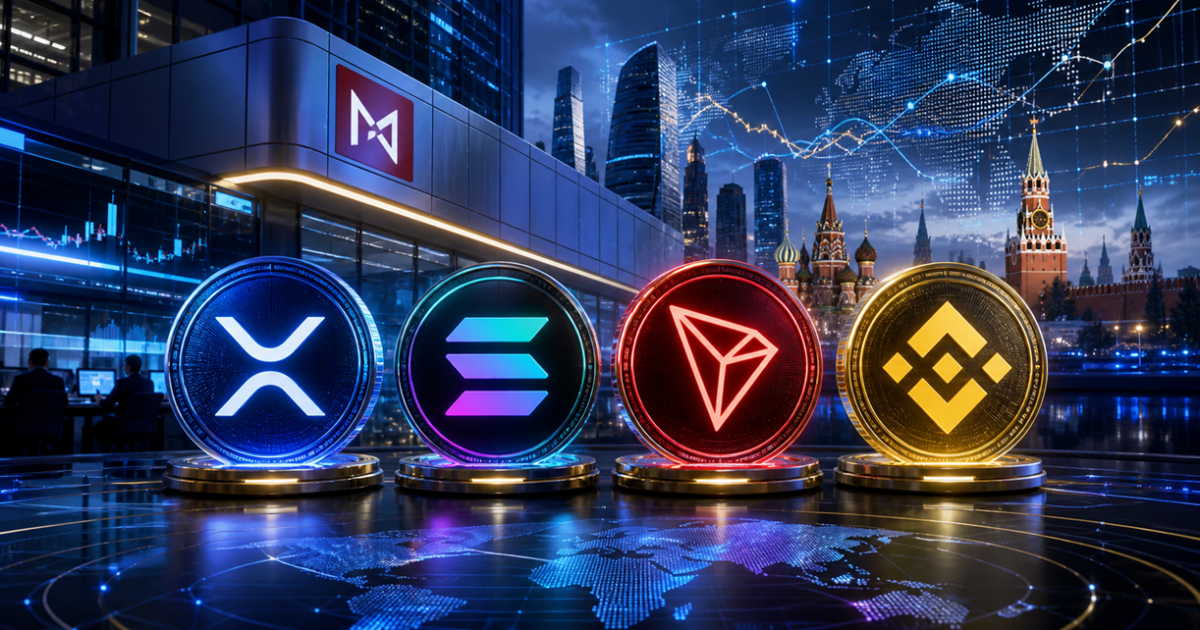
Moscow Exchange will debut crypto indices for XRP, Solana, Tron, and Binance Coin on May 13, marking the next phase of Russia’s regulated digital-asset expansion. The four new indices—MOEXXRP, MOEXSOL, MOEXTRX, and MOEXBNB—will join existing Bitcoin and Ethereum benchmarks, with calculation frequency accelerating to every 15 seconds. The move signals Moscow Exchange’s strategy to build infrastructure for institutional crypto derivatives ahead of direct cryptocurrency trading expected in early 2027.
Russia’s Regulatory Green Light for Crypto Infrastructure
The Bank of Russia permitted financial institutions to offer crypto-linked derivative instruments in May 2025, establishing the legal framework for Moscow Exchange’s expansion. Unlike direct crypto ownership, these derivatives allow professional investors to gain price exposure without physical asset settlement. Moscow Exchange launched Bitcoin and Ethereum futures in November 2025, validating the institutional appetite for regulated crypto products. The new indices represent a deliberate widening of that universe, extending beyond the two largest assets to mid-cap ecosystems.
Index Design: Four-Exchange Data Feed
Moscow Exchange sources price data from four major global exchanges, weighted by trading volume and liquidity: Binance contributes 50 percent of input data, Bybit 20 percent, OKX 15 percent, and Bitget 15 percent. This multi-source methodology reduces single-exchange manipulation risk and reflects genuine market pricing. Starting May 13, all digital currency indices—including the existing Bitcoin and Ethereum benchmarks—will shift from daily publication to real-time updates every 15 seconds during trading sessions and weekend hours. Maria Silkina, chief product manager for Moscow Exchange’s derivatives market, emphasized the indices’ role as potential underlying assets for future financial instruments.
Roadmap: From Indices to Direct Trading
Moscow Exchange plans to expand the index universe to 10 assets, with Dogecoin, Cardano, Hyperliquid, and Chainlink among planned additions. The indices serve as intermediate infrastructure before direct cryptocurrency trading launches in early 2027. For now, Russian professional investors remain restricted to derivative exposure; retail access remains prohibited. This staged rollout mirrors jurisdictions like Switzerland and Singapore, where regulated derivatives precede spot trading. The indices’ transformation into tradeable instruments could accelerate institutional adoption within Russia’s constrained but growing digital-asset market.