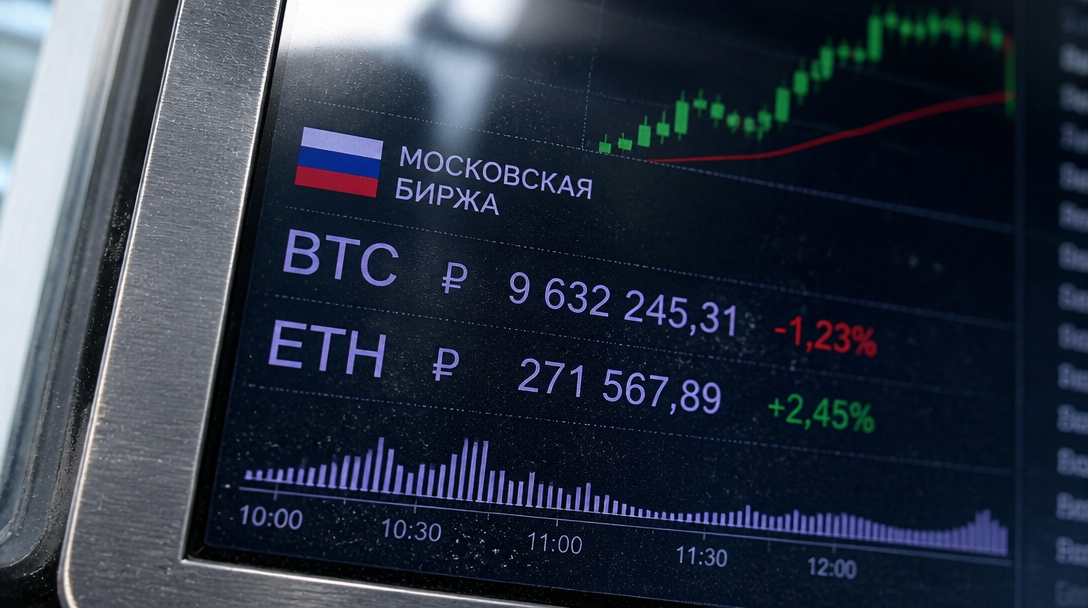
Moscow Exchange will begin trading Bitcoin, Ether, and Tether’s USDT on December 1, marking what the exchange describes as Russia’s first organized digital currency market. The launch follows Russia’s crypto law, which took effect in September, permitting regulated cryptocurrency trading while maintaining a ban on crypto payments for goods and services within the country.
Non-qualified investors will face strict limits. Buyers must pass a test before purchasing crypto and are capped at 300,000 rubles (approximately $3,700) in annual purchases per broker. The exchange did not specify what test non-qualified investors must pass or whether qualified investors face different limits.
Trading will operate from 6:50 am to 11:50 pm Moscow time using Moscow Exchange’s existing stock-market infrastructure. Trades will be cleared through the National Clearing Center (NCC), with same-day and next-day settlement and swap transactions supported initially. Pilot trades will begin as participants join the platform.
Skepticism Over Market Viability
Sergey Mendeleev, founder of Exved, a Russian cross-border payments platform, expressed doubt about the exchange’s competitive positioning. “Neither the global nor the local market will notice anything at all,” Mendeleev said, citing the unfavorable conditions for retail participation.
Mendeleev characterized the restrictions as economically unviable for ordinary investors. “For ordinary non-qualified investors, this is an entirely unattractive and unprofitable proposition,” he said, pointing to what he described as “absolutely outrageous spreads.” Competitive crypto trading markets typically operate at spreads as narrow as 0.05%, suggesting Moscow Exchange’s quoted pricing could be significantly wider.
Mendeleev also suggested potential for the platform if structured to support cross-border payments differently. “I hope this will mark a genuine breakthrough for foreign trade,” he said, though he did not elaborate on specific structural changes needed.
Sanctions Context
Moscow Exchange and NCC have operated under US sanctions since June 2024. The UK also sanctioned the exchange in June 2024, and the European Union added it to its sanctions list in July 2026. Moscow Exchange did not provide official rationale for proceeding with the launch despite these restrictions.
Russia plans to ban direct peer-to-peer cryptocurrency trades in July 2027, further restricting how citizens can access digital assets outside regulated channels.