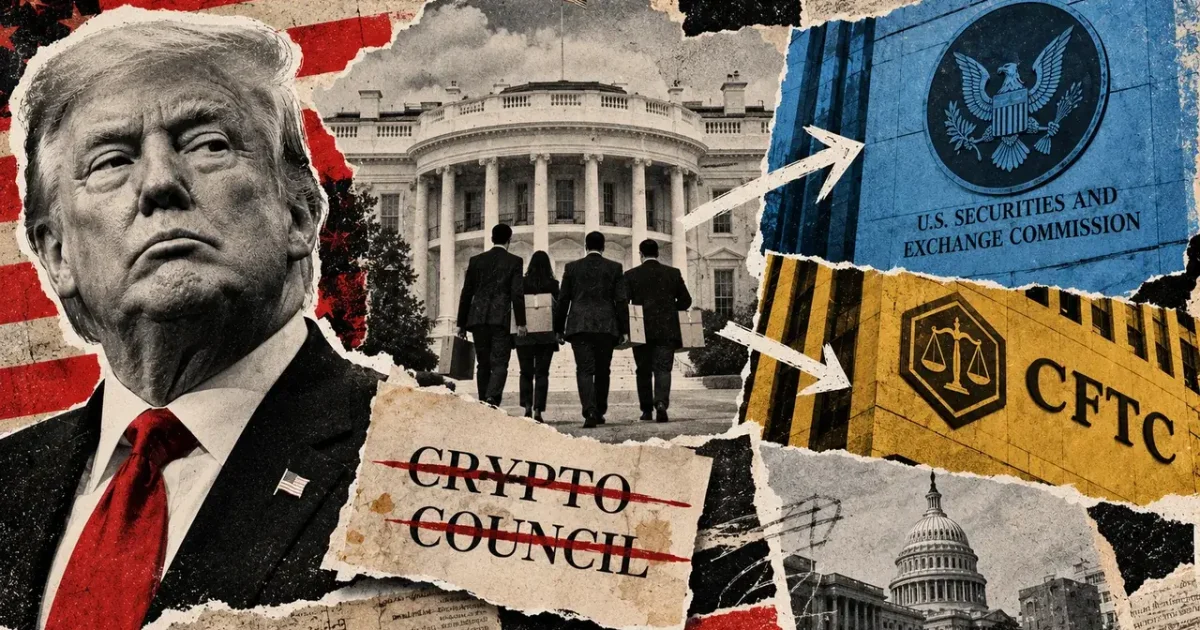
Patrick Witt, executive director of the White House Crypto Council, has confirmed his departure from the administration after nearly two years, removing the lead White House negotiator from stalled legislative talks over the CLARITY Act.
Witt’s exit marks the fourth senior departure from the crypto policy team under President Donald Trump. David Sacks, the original White House crypto and AI czar, departed in March 2025. Bo Hines, who directed the White House Crypto Council, left in August 2025. Harry Jung, deputy director of the council, departed in July 2025.
In a statement, Witt called his tenure “the privilege of a lifetime.” Alexander Grieve, government affairs executive at Paradigm, characterized Witt’s two years navigating the role as one where he alternated “between legislative technician, negotiator and political strategist to keep the CLARITY Act moving.”
Legislative Stalemate Deepens
The House approved its version of the CLARITY Act in 2025, intending to establish a comprehensive regulatory framework for digital assets. A Senate procedural vote on the bill failed in September 2025. Days before that vote, Witt warned that failure “could delay comprehensive cryptocurrency rules for years.”
Senate disagreements over the CLARITY Act center on stablecoin rewards, banking competition, and potential conflicts of interest involving Trump’s cryptocurrency businesses. Banks have pushed to restrict rewards on stablecoin holdings, arguing such arrangements could divert deposits from traditional institutions. Cryptocurrency companies have resisted restrictions, warning they could undermine competition.
Democrats have demanded stronger safeguards addressing Trump’s financial interests in cryptocurrency ventures, questioning whether restrictions could be enforced if the Justice Department decided whether to bring action against the president.
Brian Armstrong, CEO of Coinbase, praised Witt’s work, noting his “determination, problem-solving ability, and capacity to work with people holding competing interests.”
Regulators Advance Independent Frameworks
As legislative negotiations stall, the Securities and Exchange Commission and Commodity Futures Trading Commission are advancing parallel regulatory approaches. On October 1, 2025, the SEC under Chairman Paul Atkins proposed a cryptocurrency custody framework. The CFTC under Chairman Michael Selig opened a consultation on leveraged retail cryptocurrency commodity transaction rules on October 5, 2025.
The SEC has also pursued rules covering cryptocurrency issuance and tokenized securities, including an Innovation Exemption for trading tokenized NMS stock and an August proposal for regulatory exemptions covering crypto fundraising.
Atkins has previously acknowledged that congressional legislation remains essential to creating durable cryptocurrency rules that future administrations would find harder to reverse, suggesting that regulatory action alone cannot achieve the permanence lawmakers seek.
During Witt’s tenure, Congress passed the GENIUS Act, which established federal rules for payment stablecoins.