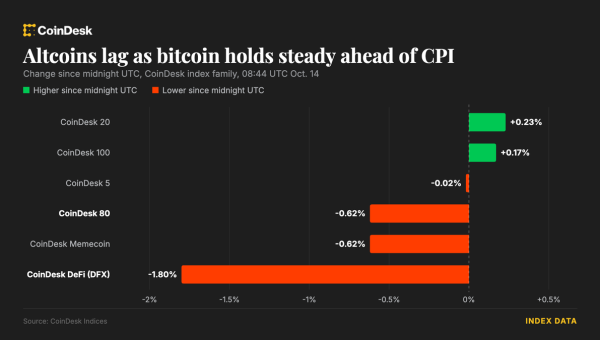
Bitcoin fell below $83,000 on Wednesday after the US Bureau of Labor Statistics released hotter-than-expected core inflation data, triggering a wave of liquidations across leveraged positions and reviving expectations of a Federal Reserve rate hike this month.
US core inflation accelerated to 2.6% annually in September, up from 2.4% in August and above the 2.4% consensus forecast. Headline consumer prices rose 3.7% year-over-year, compared to a 3.6% forecast, while core prices increased 0.3% during the month, exceeding the 0.2% consensus estimate. The reading marked the 67th consecutive month that US inflation remained above the Fed’s 2% target.
The data immediately shifted market expectations for the October 27–28 Federal Reserve policy meeting. Kalshi, a prediction market, showed October rate hike odds rising from 21% to 55% following the inflation release. “Core at 0.3%, above consensus, puts an October hike back in play after the market had faded it to one in five,” said Can-Luca Köymen, investment strategist at Sygnum Bank.
The inflation shock triggered $100 million in liquidated leveraged positions within one hour, according to CoinGlass, a cryptocurrency derivative data analysis platform. Total liquidations across the 24-hour period reached $220 million. An earlier wave of forced position closures totaling $800 million had raised concerns that leveraged traders remained exposed despite recent risk reduction efforts.
Energy costs were the largest contributor to September inflation. Gasoline prices surged 9.1% during the month as the broader energy index climbed 5.2%, reflecting fallout from ongoing US-Iran conflict. Inflationary pressures also spread to shelter, used vehicles, recreation, education, air travel, and medical services. Shelter costs increased 0.4%, while used vehicle prices climbed 0.7%.
The inflation data sent Treasury yields higher. The benchmark 10-year Treasury yield rose 7 to 9 basis points during the session. Higher Treasury yields increase the appeal of interest-bearing assets and can weaken demand for speculative investments like Bitcoin, which offers no yield.
The Fed raised its benchmark interest rate by 25 basis points in September to a 3.75% to 4% range, marking its first increase in more than three years. The Fed’s preferred inflation gauge, the PCE index, is scheduled for release on October 29, the day after the October policy meeting concludes.
Despite the liquidations, spot Bitcoin demand showed signs of recovery. According to CryptoQuant, an analytics platform, total demand increased by approximately 69,000 BTC after two consecutive months of weakness. Ryan Lee, chief analyst at Bitget Research, noted that market structure in October resembled August, which historically accompanied bullish phases in Bitcoin’s cycle.
Bitcoin’s immediate support level was identified at $81,300, according to Lewis Huang, an analyst at Bitget.