Minority investigation scrutinizes stablecoin issuer’s compliance timeline
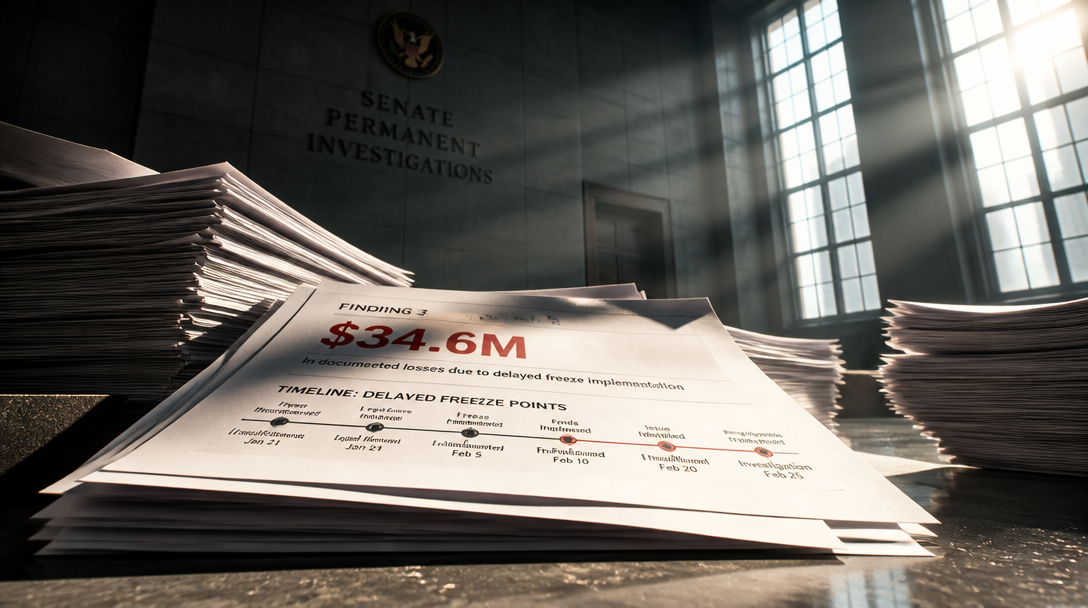
A Senate Democratic minority report released September 28 alleges that Tether delayed blacklisting Iran-linked cryptocurrency wallets, permitting $34.6 million in USDT to transfer before freezes took effect. The report from the Senate Permanent Subcommittee on Investigations, led by Connecticut Democrat Richard Blumenthal, analyzed 846 crypto wallets designated by US and Israeli authorities over five years through August 2026.
The subcommittee found that 84% of the analyzed wallets transacted exclusively or nearly exclusively in USDT, underscoring the stablecoin’s role in the network. Of 39 wallets Israel’s National Bureau for Counter Terror Financing identified in June 2023 as linked to Tawfiq Muhammad Sa’id al-Law, an individual sanctioned for providing financial services to Hezbollah, only five had been blacklisted. The remaining 34 wallets remained unfrozen until March 2024, nine months after the Israeli notice.
The report highlights a specific case: after Israel’s seizure notice, $34.6 million in USDT moved out of wallets before the remaining addresses were frozen. Blumenthal referred the findings to the Treasury Department and Department of Justice, asking them to investigate Tether’s anti-money laundering and sanctions compliance. The referrals do not establish that Tether violated federal law, and neither agency has publicly confirmed opening a new investigation.
Tether CEO Paolo Ardoino countered the findings in a statement, saying the company “acts when authorities provide credible information.” Tether claims it froze approximately $550 million in USDT across Iran-linked wallets during 2026. The company disclosed two major enforcement actions: freezing more than $344 million across two addresses on April 23, 2026, and more than $130 million across four wallets in July 2026 after the US Treasury expanded Central Bank of Iran listings.
Tether did not provide a wallet-by-wallet breakdown reconciling its disclosed examples with the full $550 million headline total. The company also did not directly address the delayed-freeze example or the broader 846-wallet analysis in its statement.
Tether retains issuer-level controls allowing it to blacklist addresses and prevent USDT from moving across blockchain networks. USDT is designed to track the US dollar and move without conventional bank transfers.
As of the report’s publication, Tether had not responded to an information request the subcommittee sent on June 4. A separate US forfeiture case seeks approximately $61 million in cryptocurrency allegedly tied to black-market Iranian oil sales, with prosecutors alleging the wider network moved more than $1.5 billion in proceeds.