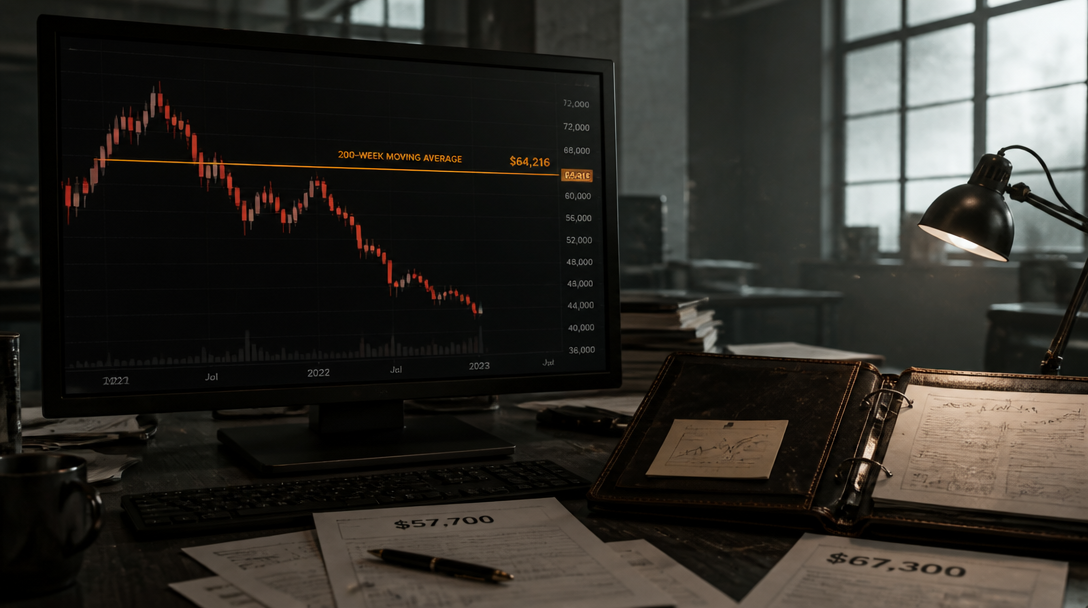
Bitcoin confirmed a weekly candle close below its 200-week moving average on August 17, marking only the second time in four years the asset has fallen beneath this technical level. The move mirrors price action from summer 2022, when Bitcoin capitulated below the same benchmark during the prior bear market.
Bitcoin opened the week at $63,000 and traded between $57,700 and $67,300. The 200-week moving average sits at $64,216. On Sunday, Binance recorded 674,332 BTC in reserves, a 2.57% increase month-to-date and the highest level since November 2025.
Benjamin Cowen, an analyst tracking the pattern, noted the symmetry: “What is interesting is how in both summer 2022/2026, Bitcoin capitulated below the 200W SMA, then bounced, then gave it up in mid-August.” The 2022 precedent saw further downside follow the breakdown.
Rekt Capital, a trader and analyst, set a weekly-close target of $63,220. “A rejection from $63,220 would fully confirm the breakdown and send price lower within the current ~$58,000-$66,000 Range,” Rekt Capital stated. The local high on Bitstamp reached $63,655 during the period.
Macro Headwinds and Fed Uncertainty
Monetary policy signals remain mixed. The Federal Reserve’s current target rate range is 3.50-3.75%, and CME Group’s FedWatch Tool shows 70% odds of a hold at the September FOMC meeting, up from 42% one month prior. The Fed is scheduled to publish July meeting minutes on Wednesday, August 21.
Inflation data shows the year-on-year CPI at 3.4%, above the Fed’s 2% target. Beth Hammack, president of the Cleveland Federal Reserve Bank, questioned the pace of rate cuts: “Maybe we’d get there, but if it takes another three to four years to get there, is that OK? Is that enough?”
PMI data is scheduled for release Friday, August 22, and will provide additional context on economic momentum heading into the September meeting.
Japan’s Rate Normalization and Global Spillovers
Japan’s second-quarter GDP grew 1.1% year-on-year and 0.3% quarter-on-quarter, below expectations of 2.0% and 0.5% respectively. The Bank of Japan’s current rate sits at 1.0%, and a rate hike is expected in September 2026.
Japan’s 10-year bond yield reached 2.93% on Monday, approaching its 1996 high. The Japanese yen traded near 159 per US dollar, near four-decade lows. Norihiro Yamaguchi, lead Japan economist at Oxford Economics, warned: “The boost to consumption from policy measures is already fading, and inflation will increase in H2 as firms will pass on increased costs, deteriorating consumers’ purchasing power.”
Axel Adler Jr., a CryptoQuant contributor, flagged the convergence of global tightening signals. “For now, this is not a signal to sell risk assets. But the market is approaching an important point: JGB greater than 3% plus further BOJ rate hikes plus a stronger yen plus rising US Treasury yields. If these factors align, Japan’s rate normalization could turn into a global tightening of financial conditions and hit stocks and Bitcoin.”
Equity Markets and ETF Flows
The S&P 500 set an all-time high of 7,816 on August 7. Despite equity strength, US spot Bitcoin ETF net outflows reached $267.2 million last week, though one trading day recorded $7.8 million in net inflows.
BlackRock’s Bitcoin ETF holdings rose 23% in the second quarter. Binance’s whale ratio, a measure of large-holder concentration, reached 0.71 on August 10.
University of Michigan consumer sentiment data is expected to show a 7.6% drop in August. Farside Investors and other tracking services monitor institutional and retail positioning as traders assess the technical breakdown and macroeconomic backdrop.