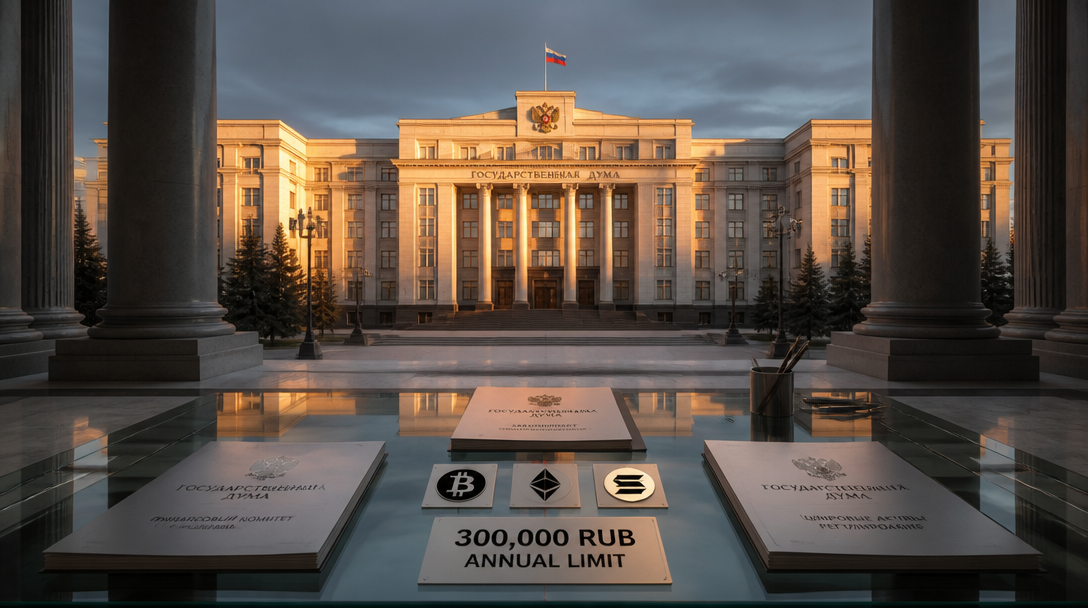
Russia’s State Duma passed its first comprehensive cryptocurrency regulation framework on July 21, 2026, creating a state-licensed system for exchanges, brokers, and depositories while capping retail investor purchases at 300,000 rubles (approximately $3,800) annually.
The bill, numbered 1194918-8, advanced through second and third readings in a single session. Anatoly Aksakov, chairman of the Duma Committee on Financial Markets, said the law was “aimed at creating legal conditions for the functioning of cryptocurrencies in our country” and that the committee had “maximally” weighed industry feedback in drafting it.
The framework licenses five categories of participants: exchanges, brokers, management companies, depositories, and exchangers. Licensed firms must hold a minimum of 15 million rubles (approximately $190,000) in capital. The Bank of Russia will serve as the licensing authority and begins accepting applications on September 1, 2026, when the law’s main provisions take effect. A grace period extends until July 1, 2027, after which unlicensed exchange activity becomes illegal.
Purchase and Transfer Limits
Non-qualified retail investors face strict annual caps: 300,000 rubles for crypto purchases and 100,000 rubles for transfers to foreign or third-party accounts. Qualified investors, defined partly by prior crypto experience, may purchase up to 3 million rubles annually and transfer up to 1 million rubles abroad. Both investor classes must pass a risk-awareness test before trading.
The law defines “systematic” exchange activity as two or more deals per month, triggering licensing requirements for individuals or firms engaging in such activity.
Asset Eligibility and Privacy Restrictions
Assets must meet strict thresholds to trade on organized venues: a 5 trillion ruble average market cap and 1 trillion ruble average daily volume. Early trading is expected to be limited to bitcoin and ether, with solana a possible third candidate. Privacy coins that hide transaction data are barred from trading entirely.
The law recognizes digital assets as property but does not legalize cryptocurrency as payment for goods and services inside Russia. The ruble remains the sole lawful currency for domestic transactions.
Cross-Border Trade and Sanctions Context
A key provision legalizes cross-border settlement of foreign trade in cryptocurrency, creating a state-supervised channel outside the dollar-and-euro banking system targeted by Western sanctions. Large transfers to foreign or third-party accounts face a 48-hour hold period.
Tax treatment will track securities rules, with rates to be set in implementing regulations. The law relies on monitoring transaction volumes and account balances rather than requiring disclosure of individual wallet addresses.
Policy Reversal After Years of Dispute
The passage marks a sharp reversal from January 2022, when the Bank of Russia proposed an outright ban on crypto transactions and mining. Four years of infighting between the finance ministry and central bank over crypto policy preceded this framework. In August 2024, President Vladimir Putin signed an experimental law permitting mining and international crypto payments, signaling the policy shift that culminated in this comprehensive regulation.
The State Duma’s passage does not conclude the legislative process. The bill must still be approved by the Federation Council, Russia’s upper legislative chamber, before it can be signed into law.