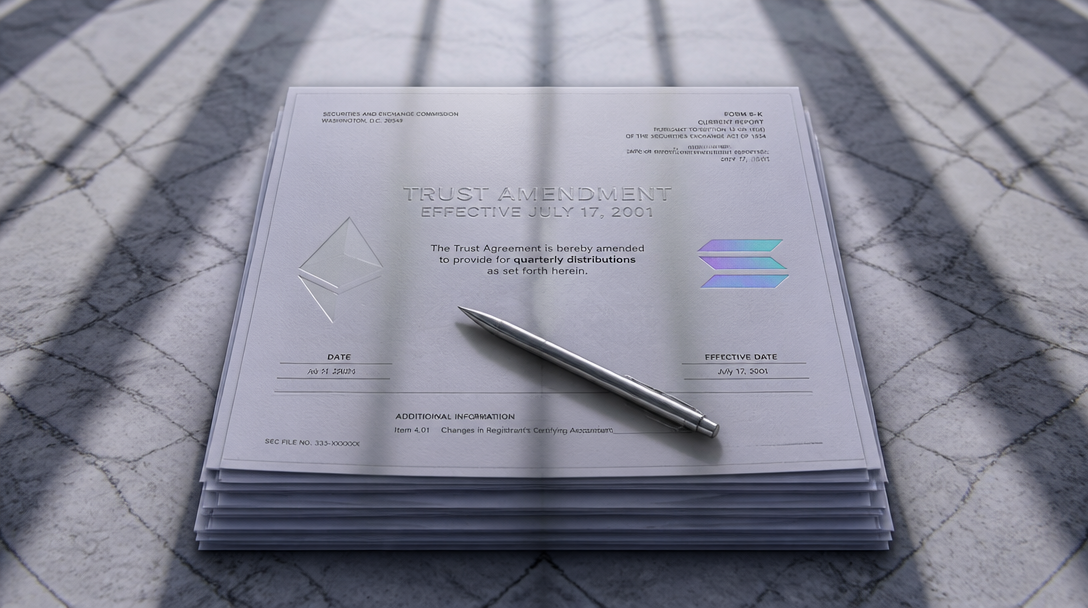
Grayscale submitted SEC filings on July 17 to amend its Ethereum Staking ETF (ETHE) and Solana Staking ETF (GSOL) trust agreements, converting staking rewards into cash distributions paid to shareholders at least quarterly.
The amendments align with the IRS framework under Revenue Procedure 2025-31, which permits grantor trusts to distribute net staking rewards with a minimum frequency of quarterly payouts. Grayscale’s structure requires the trusts to sell native-asset rewards (ETH or SOL) before distributing net proceeds to shareholders.
ETHE already demonstrated the cash distribution model on January 6, 2026, when it paid $0.083 per share to holders, totaling $9.39 million. That payout represented staking rewards earned between October 6 and December 31, 2025.
Quarterly Schedule and Tax Treatment
The proposed quarterly schedule sets a minimum distribution frequency but does not lock payment amounts. Actual payouts depend on staking rewards received, trust expenses, and tax consequences. U.S. holders recognize pro rata staking rewards as taxable income when the trust receives them, regardless of when distributions occur.
Selling ETH or SOL to fund payouts can generate pro rata capital gains or losses for shareholders. The amendments do not specify an exact implementation date, though distributions are planned to begin around August 7.
Market Context
Staking-focused crypto products have drawn significant institutional interest. Single-token ETFs attracted $13.6 billion in inflows, according to data cited in related market analysis. Grayscale’s move to formalize quarterly cash distributions addresses a structural requirement under current tax guidance for grantor trusts holding proof-of-stake assets.
The filing does not disclose the current staking reward rates for either ETHE or GSOL, nor does it specify the expense drag or fees charged on these trusts.